By Mackin Bannon
Share

February 1, 2023

Sendout testing is one of the largest expenses for labs, from large reference labs and health systems to smaller clinical labs and medical facilities. With some labs spending millions of dollars a year on sendouts across dozens of reference labs while being asked to cut costs wherever possible, it is imperative to closely monitor sendout testing costs and performance.

Here are four steps you can take to improve your lab’s sendout testing process.

1. Standardize where similar lab tests are being sent

Most labs expect to send tests out to multiple different reference labs. Different labs have different specialties, and some may offer better pricing or faster turnaround times than others.

Multi-site organizations—whether a health system or a large commercial lab—face a different challenge. Often, different ordering locations within an organization send the same or similar tests to different reference labs. This can occur due to: 

  • An organization making an acquisition, but leaving operations as-is
  • Lack of communication between departments or locations
  • Simply, lack of visibility into the data

Take a look at your sendout data across all your locations and identify any instances where this may be occurring. See if there are opportunities to consolidate where your locations are sending the same or similar tests. Whether you look to achieve the lowest price, the fastest turnaround time or a balance of the two, standardizing your sendout process will help save significant time and effort.

2. Optimize pricing to reduce sendout spend

As mentioned earlier, sendouts are one of the biggest bills in the lab. And with healthcare organizations facing more and more pressure to reduce costs, that sendout bill is a logical place to start.

The first step to optimizing your sendout spending is to analyze all your data across your various reference labs. Identify the reference labs and tests with the highest costs, then work with those vendors to negotiate better rates or move specific tests to another lab with lower prices. Continue to analyze this data over time to ensure you’re always getting optimal prices.

Additionally, you can look internally and identify specific ordering locations or providers with higher-than-expected spending on sendouts. Work with those groups to optimize their test ordering behavior to help reduce spending where possible.

3. Drive accountability on sendout turnaround time

Consistent turnaround time delays can have a significant impact on both patient care and the bottom line, from the inconvenience and added cost of redraws to the loss of partnerships due to missed service level agreements (SLAs).

It is important to regularly monitor turnaround time data for each of your reference labs to ensure they are meeting their SLAs. When they are not, have that data on hand to drive accountability and ensure that your reference labs perform as expected.

4. Assess whether certain sendouts should be brought in-house

With all this data in hand, you are likely to uncover specific sendout tests that cost too much, are not being turned around fast enough or both. If you are unable to drive change through your reference lab to lower costs and/or turnaround times, another option to consider is bringing the tests in-house.

Assess what it would cost to run the specific tests in your lab, factoring in supplies, staffing and any equipment that would need to be purchased. Additionally, determine what a realistic turnaround time would be for your lab to perform the test.

Compare both sets of numbers and, based on your organization’s priorities, make the decision on whether it would be worthwhile to bring the sendout tests in-house.

Next Steps

While the above steps may sound great in theory, many organizations lack the insights they need to make these types of informed decisions on their sendout testing. While reference labs often provide utilization reports with data on the sendouts they receive, each lab sends a different format, the data is not in real-time and there is no way to verify the information.

To overcome these challenges,  hc1 has developed a solution to help labs transform their sendout process.

hc1 Sendout Management™ consolidates data across all your reference labs to provide real-time insight into performance and cost to inform operational decisions. Intuitive dashboards include key metrics like volume, total and average spend and turnaround time, enabling lab management to standardize their sendout process, ensure they are getting the best prices and drive accountability on performance benchmarks.

Are you ready to get started on optimizing your sendout process and spending? Request a demo of hc1 Sendout Management today.

_______________________________________________________________

Mackin Bannon is the product marketing manager for hc1. Mackin held a variety of roles covering nearly every area of marketing before settling on product marketing as a focus and joining hc1 in 2022. During the workday, he enjoys bringing stories to life in clear and creative ways, and in his free time, he enjoys following his favorite sports teams, collecting vinyl records and exploring Indianapolis.
By Lorri Markum
Share

December 20, 2023

A special webinar, now on-demand here, for hc1 Sendout Management™, presented by hc1 experts, reveals background information about hc1’s core platform — hc1 Lab Insights Platform™ comprised of hc1 Analytics™ and hc1 Operations Management™ all of which help inform workflow management, analytics and precision health through easy access, high-quality specific data.

hc1 experts shared information about why Sendout Management was developed and highlighted key features of the solution, noting how this unified platform ensures the ability to monitor sendout TaT to drive accountability and improve care, the ability to optimize pricing to reduce sendout spend and standardizing lab sendout testing processes. “Our goal with Sendout Management was to streamline and standardize sendout data, so lab managers have easy-to-understand reports and dashboards available at their fingertips,” Adam Sajewich, hc1 high value care director, stated.

An introduction and demonstration of the functionality of hc1 Sendout Management in real-time and shows what this solution brings to the hc1 Lab Insights Platform. The ease-of-use dashboards allow both at-a-glance information and quickly accessible, granular information through filter features, such as ordering location type, panel/test name, sendout lab name, ordering provider and more. You can also quickly download and export reports directly from the dashboard. Moyer highlighted the solution’s capability to automate and deliver KPIs or dashboards and send them to decision-makers instantly to empower strategic changes.

Sendout testing is one of the most significant expenses clinical and health system labs experience today, but sendout testing hardships aren’t new, as noted in the 2009 article, “Explosive Growth of Send Out Testing: Can We Curb the Monster?”, published by AACC. With more than 7 billion clinical lab tests performed in the U.S. each year providing critical data, the challenge to meet the demands placed on laboratory staff and health systems is extreme. hc1 Sendout Management helps labs gain the insights they need to assess reference labs’ performance regarding sendout testing, hold them accountable to SLAs and find the best price. 

“Managing Sendout Testing is one of the top requests we [hc1] have received from our customers [and the market] over the past five years. In conjunction with increasing costs and the lab staffing crisis, the lack of transparency and standardization has made it more important than ever to bring our hc1 Sendout Management solution to the market to serve our customers, providers, and patients alike,” presenter John Moyer, hc1 sr. product director said.

Attendees asked great questions:

  • “How does hc1 determine if performing labs are meeting the SLA TaT?”
  • “How is sendout cost, per test, derived to calculate total sendout spend?”
  • “What if we have multiple sites using different LISs or EMRs, how would hc1 handle that?”
  • “What if our lab uses miscellaneous tests per sendouts? Can we still track those?”
  • “Do you calculate the cost per test in an organization or would this information be provided?”
  • “What is the typical lead time from the signed contract to the launch of this product for a customer?”

Watch on-demand here, learn the answers to the above questions, and see the complete webinar.

hc1 Sendout Management is available to both new and existing customers. Contact us today to get started if you would like a custom demo.

hc1 was built from the ground up for healthcare and is cloud-based, allowing better cross-communication and access to data within a health system. We were made to enhance labs and are 100% tailored for healthcare. Our solutions help you realize the value in your data from billing codes, naming conventions, diagnosis codes, ICD-10 codes, specimen IDs and more.

_________________________________________________________________________

Lorri Markum is the marketing manager for hc1 Insights and has over two decades of corporate and nonprofit marketing leadership experience. Lorri specializes in B2B marketing and SEO optimization. Before joining hc1, she was the marketing manager for a nonprofit healthcare organization serving 40 counties throughout Indiana.

By Heather Stith
Share

November 28, 2023

In the recent article “Why Big Data Science and Data Analytics Projects Fail,” Data Science Process Alliance consultant Nick Hotz outlines common problems all data project teams face and the questions that need to be answered for a data project to succeed. Since 2011, hc1 has been helping health systems and laboratories analyze their laboratory testing data to improve patient care. Our approach to resolving data project problems for our customers is rooted in our core values. I spoke with hc1 data scientist Alex Karr, for more details about this approach.

Hire curious people and develop their talents

Hotz mentions the difficulty of finding people with the appropriate data skills in today’s competitive market. What he doesn’t say is that organizations can choose to invest in developing the skills of the people they already have. Karr is a great example of this kind of career growth. He started with hc1 as an intern writing training documentation for our business intelligence team. When he was hired full-time, he learned to write queries and develop reports as an analyst. He then used his deep knowledge of the hc1 database to move into a data engineering role with the data team to manage their ETL (extract, transform, load) processes. While continuing to work at hc1, Karr earned his master’s degree in data science and was promoted to his current position.

“For me, the natural progression was we’ve got all this data, how do we actually make insights out of it? Of course, one way is doing visualizations for a client, but what I was more interested in was machine learning, so, you know, how can we make predictions based on what we have,”  Karr said.

Be accountable for data quality

As the Data Science Process Alliance article points out, not having the right data is the clearest reason for data project failure. “Not having the right data is pretty critical, because we can work with what we’ve got, but it’s always gonna have limitations. We have to make sure that we recognize those limitations and try to account for them, ” Karr said. He explained some of the ways we do this:

  • Integrating data from multiple sources. Lab testing data comes from systems that are designed to collect the information necessary for reimbursement, not operational or patient care improvement, so there are likely to be gaps in the information that can be gleaned from it. For example, we might need to look at medical claims data to get full diagnosis information or add financial data to present a complete picture of lab operations.
  • Cleaning data. Our patient matching process de-duplicates patient records so that we can build data models from a more manageable, performant dataset. Standardizing the format of zip code and state data points, for example, is important in public and population health use cases that involve patient geography, such as evaluating the risk of COVID-19 spread or tracking changes in opioid overdoses.

Standardizing test names and abbreviations and comparing test codes, analytes, and units of measure to determine whether tests with similar names are in fact referring to the same test is an essential part of making sure that the insights we provide for test utilization and order volume are accurate.

  • Evaluating data for bias. When compared with U.S. Census data, our dataset reveals a slight overrepresentation of women, for example. Knowing that fact allows our data scientists to adjust data models to reflect patient gender ratios that align with U.S. population numbers. 

At this point in the interview, Karr started getting into concepts that reminded me that not all hc1 technical writers (namely me) are destined to become data scientists. He spoke about imputation and overfitting and data leakage. Mostly, I understood that a major part of building a machine learning model is figuring out which data points to include and which ones to exclude, a process called feature selection. He also stressed that it’s important to separate your training data from your testing data.  

Use a collaborative project management process

The Hotz article lists ineffective project management processes as a reason for data project failure and recommends the Agile methodology, which is what the hc1 technology department uses, as a solution. As hc1 practices it, Agile means small, focused teams of product owners, software engineers, business and data analysts, and data scientists work together in two-week-long sprints to complete defined blocks of work. Breaking up the work in this way provides the flexibility to incorporate customer feedback and adjust to changing priorities. It also shortens the amount of time required to deliver value. Frequent communication and collaboration are essential to making the Agile process work, as is keeping the focus on the problem the customer is trying to solve. Although data science doesn’t often fall neatly into defined deliverables—many sprints are devoted to research—Karr finds the structure and clear goals of Agile to be helpful, especially when he splits his time among different teams and projects.

Handle data ethically

As a healthcare technology company, hc1 safeguards the protected health information in our systems in accordance with the Health Insurance Portability and Accountability Act of 1996 (HIPAA).

hc1 was founded on the belief that every patient should be treated as a unique individual and that if labs could organize every individual’s information intelligently, they could personalize and improve care for all patients. Now, hc1 solutions optimize laboratory operations for thousands of locations and inform testing and treatment decisions for millions of patients. Click here to learn more about the hc1 Platform which has organized diagnostic data for over 200 million patients and processes more than 30 billion clinical transactions and 500 million test results per month.

By Lorri Markum
Share

October 11, 2022

Laboratory testing plays a decisive role in the early detection, diagnosis and treatment of disease in patients and is the single highest-volume medical activity performed in the U.S., with more than 7 billion tests conducted annually, according to the American Clinical Laboratory Association. Test orders aren’t always perfect, however. Often, a duplicate or unnecessary test is ordered or a needed test is omitted, which can negatively impact the quality of care a patient receives. 

Lab Stewardship has emerged as a strategy to assure quality in laboratory medicine to provide the right test for the right patient at the right time. The American Association for Clinical Chemistry (AACC) refers to lab stewardship as correctly ordering, retrieving and interpreting lab results. Errors in these three aspects of the total testing process are the culprits for most diagnostic errors and are the cause of the majority of significant patient harm in malpractice litigations. 

On September 21, 2022, Quest Diagnostics, in collaboration with hc1, hosted a virtual webinar on the importance of Lab Stewardship entitled How to Close Gaps in Care by Maximizing the Power of Laboratory Stewardship Solutions. 

Experts, Donna D. Cooper, MS, MBA, Sr. Director, Health Systems Product Solutions, Quest Diagnostics and James Haarbauer, MS, Sr. Business Intelligence Consultant, hc1, shared their lab stewardship strategies for hospitals and health systems including:

  • The 4 basic elements of an effective Laboratory Stewardship program
  • Key criteria when building a Laboratory Stewardship Committee
  • 3 ways lab stewardship solutions improve patient care and outcomes
  • How to identify low-impact versus high-impact interventions

“Lab stewardship is the opportunity to manage hospital and laboratory resources in a way that provides optimal information to clinicians while reducing costs to patients, hospitals, and health systems,” said Cooper, “Effective committees need a balance of three qualities in order to be successful–Influencers, Informers and Doers.”

Cooper went on to provide details on how to form a solid lab stewardship committee and the importance of governance, intervention, and pipeline from a granular approach. “Getting the right people at the table is critical to the success of any Lab Stewardship Committee,” said Cooper.

Lab Stewardship also requires lab data insights that can be cumbersome to interpret in identifying areas of concern for the health systems they support. However, “the burden of deciphering lab data can be removed from the medical and lab leadership with just an LIS connection––health systems can begin using hc1 dashboards to identify the greatest improvement opportunities by test, location and provider,” said Haarbauer.

Quest Lab Stewardship powered by hc1 empowers health systems to maximize the utility of their laboratories with intuitive analytics and advisory services that provide actionable insights into laboratory testing trends that can identify missed opportunities to deliver the right test to the right patient at the right time. 

One of the questions posed by attendees during the webinar’s question and answer session was whether it is easy to access the lab stewardship platform. Cooper explained, “There are two ways to access the lab stewardship platform in a system. Quest offers tiered access through the Reference Platform to allow users to see data on any test that is sent through Quest. The Enterprise Platform allows users to establish an interface with hc1 and will be able to enter data for all in-house testing as well as testing sent to Quest or any laboratory so users will have a full picture of all testing information.”

To learn more in-depth information that was shared, you can view the webinar on-demand by clicking here.

By Heather Stith
Share

October 6, 2022

Changes in seasons often accompany changes in diet, environment and behavior. Such changes can have a cascading effect on health, particularly for people who take prescription medication. Precision prescribing recognizes that every person has a unique combination of genetic, environmental and behavioral factors that will determine how specific medications will work for them.

The term pharmacokinetics describes how drugs move through the body—how they are absorbed, metabolized and eliminated. Pharmacodynamics describes how the drug affects the body. Food-drug interactions are how foods change a drug’s pharmacokinetics and pharmacodynamics. These changes can reduce the medication’s effectiveness or lead to adverse events. The impact of these changes can be difficult to predict because of the many factors involved: how much time elapses between eating and taking medication, the nutritional content of the food, and the amount of food eaten. Age, sex and genetics also affect how a person metabolizes food and medication. 

From Pumpkin Spice Lattes and Oktoberfest Märzens to Halloween candy and Thanksgiving  dishes,  favorite fall foods interact with drugs in different ways:

  • Licorice. Before breaking into bags of black licorice this Halloween, you may want to check with your doctor, particularly if you are pregnant or older than 40. Commonly used in herbal remedies as well as candy, licorice contains glycyrrhizin, which can lower potassium. Licorice also can raise cortisol levels. These physiological effects mean that licorice doesn’t mix well with medications for high blood pressure or cardiovascular diseases, such as ACE inhibitors or diuretics. Combining such medication and licorice can lead to irregular heart rhythms.
  • Grapefruit. Ruby Red grapefruit season starts in November, and this fruit’s sour kick can be just the ticket when your body needs a vitamin C boost. Yet grapefruit also blocks the CYP3A4 enzyme from metabolizing drugs in the small intestine, causing too much of the drug to be in your body. The affected drugs include some statins, some high blood pressure medication, some anti-anxiety drugs, and some corticosteroids. With some antihistamines, grapefruit prevents absorption of the drug, thus lowering the drug’s effectiveness. Grapefruit interactions are typically highlighted on a prescription’s warning label or the box containing over-the-counter medications.
  • Cruciferous vegetables: Thanksgiving feasts have moved beyond green bean casserole to make room for roasted Brussels sprouts and mashed cauliflower, and rightly so. These vegetables from the Brassica botanical family are low in calories, high in fiber, and packed with nutrients, such as Vitamin K. What makes them different from other vegetables is that they contain glucosinolates, compounds that show promise in reducing cancer and cardiovascular disease risk and are the cause of their pungent odor and somewhat bitter taste. 

These typically beneficial qualities can work against specific medications, however. Warfarin is a blood thinner used to prevent blood clots; whereas, Vitamin K helps make blood clotting proteins. Drastically increasing your intake of, say, kale chips or green smoothies could interfere with warfarin’s effectiveness.  Cruciferous vegetables also increase the activity of the CYP1A2 enzyme, an enzyme involved in drug metabolism. As more drugs are developed that are metabolized via this enzyme, more research will be needed to determine how diets high in cruciferous vegetables might affect the effectiveness of those drugs. 

  • Aged cheeses and meat. Charcuterie boards are not your friend if you take any of the class of drugs known as monoamine oxidase inhibitors (MAOI). MAOIs are prescribed to treat depression and Parkinson’s disease. As the name suggests, they block monoamine oxidase, an enzyme that breaks down tyramine. Our bodies use tyramine to control blood pressure, and foods such as cheddar cheese, salami and pickles are full of it. If you are taking medication that prevents tyramine from being broken down while ingesting more tyramine, you are likely to end up with too much tyramine, and too much tyramine can cause dangerous blood pressure spikes.
  • Beer, wine and liquor. Alcohol is a drug that depresses the central nervous system and can damage the liver. These effects can be increased to dangerous levels when alcohol is combined with medications that have similar effects, such as sedatives and pain relievers. For example, you may become extremely drowsy if you drink alcohol while taking medication to deal with autumn ragweed allergies. Another bad combination is alcohol and acetaminophen, which are both metabolized by the CYP2E1 enzyme and together can lead to liver toxicity.
  • Coffee. As the weather gets chillier and the days get shorter, you might pour yourself multiple mugs of coffee to stay warm and awake. Coffee contains caffeine, a stimulant, which gives coffee its bitter taste and has many different pharmacokinetic interactions with prescription drugs. Coffee interferes with drug absorption by changing stomach acid levels, for example, and interferes with drug excretion by increasing urine volume. 

Food-drug interactions are one of many patient data points providers have to take into account to create effective treatment plans. Patients will try to make themselves feel better before they ever set foot in a doctor’s office, so patient encounters should include questions about over-the-counter medications, herbal supplements, and diet changes in addition to medical history and current symptoms.

To learn how hc1 can help your healthcare organization ensure that patients get the right tests and the right prescriptions no matter the season,  request a demo!

By Heather Stith
Share

September 8, 2022

When you go to a doctor or a hospital, the reason for your visit (known as an encounter in medical terms) is assigned an ICD code. ICD stands for International Classification of Diseases, which is the worldwide standard for recording healthcare information about human morbidity (disease) and mortality (death). The World Health Organization (WHO) explains the importance of ICD as a common language for recording, reporting and monitoring diseases, allowing the world to compare and share data in a consistent and standard way—between hospitals, regions and countries and over periods of time. The diagnostic information in ICD codes supports data for use throughout healthcare, such as public health records, patient safety and high-value care initiatives, medical device and pharmaceutical development and insurance reimbursements.

Since 1946, WHO has managed the revisions of the ICD. The latest version, ICD-11, went into effect this year. According to the ICD-11 Fact Sheet, “ICD–11 is a vast improvement on previous revisions.” The new coding system is expected to improve ease and accuracy of coding and require less user training.  ICD–11 is also ready for use in multiple IT environments with a new API. By transitioning to ICD-11, healthcare organizations will open up numerous possibilities to improve research and patient care.

The BMC Medical Informatics and Decision Making journal article, “ICD-11: an international classification of diseases for the twenty-first century,” highlights these major changes in ICD-11:

  • The Foundation database: This database expands how diseases and causes of death can be described and classified. It includes support for multiple languages and details about stages or severity of disease and includes elements to track disease genomics, causes and manifestations as they are discovered. This database also allows for multiple parent and child relationships within the ICD framework to better reflect the complexity of certain diseases. For example, stroke is now in both the neurological and cardiovascular categories (called chapters in the ICD)  instead of just being in the cardiovascular category, as in ICD-10.
  • Stem codes, extension codes and unique identifiers: ICD-11 includes both stem codes for the main diagnosis and extension codes for related information, such as medication, injury location or disease cause. These codes can be clustered to provide a more detailed record of a patient’s disease. Each concept in ICD-11 also has a unique identifier. These codes and identifiers, along with the APIs the WHO has developed, make it possible for software developers to access and use the ICD coding structure.
  • New chapters: ICD-11 has chapters for sleep-wake disorders and sexual health in response to an increased focus on these medical topics since the release of ICD-10. Blood diseases and immune system diseases are now in separate chapters to reflect the differences in the causes and treatment of these diseases. A chapter for traditional medicine concepts enables medical coders to record disease information gathered from a variety of medical environments.

U.S. healthcare organizations currently use a version of ICD-10, ICD-10 CM (Clinical Modification), to classify disease data. The National Center for Health Statistics developed the ICD-10 CM and updates it annually. For example, modifications in the last few years include new codes for vaping-related disorder, COVID-19 and post-COVID-19 condition. Spend any time with the ICD-10-CM Browser Tool and you will appreciate how detailed and complex the ICD can be and why medical coders require specialized training to learn how to apply these codes correctly. Also, you might be left wondering how often the  Y93.C1 (Activity, Computer keyboarding) code is used as the cause for an injury.

The U.S. transition to ICD-11 will take several years, although hopefully nowhere near as long as it took  to fully transition to ICD-10. After many delays, the ICD-10 was fully implemented in the United States in 2015, 25 years after it was endorsed by the WHO. The National Committee on Vital and Health Statistics, which advises the Secretary of Health and Human Services on these matters, has recommended that the HHS conduct research on how to best implement ICD-11 in the U.S. healthcare system and regularly communicate the status of that research to healthcare organizations to help prevent undue ICD-11 transition costs. In its letter, “Updated Recommendations for Immediate Action on ICD-11,” the committee states, “The need for research is compelling given ICD-11 may, or may not, provide significant opportunity to reduce provider burden and increase interoperability of electronic health information – high priority goals for the U.S.”

At hc1, the hc1 Lab Insights Platform™ ingests ICD codes from an interface with a client’s electronic health record or laboratory information system and stores them in diagnosis records within that client’s hc1 environment. These records can inform insights within different solutions. For example, a client can use these codes to set diagnosis criteria for laboratory test ordering guidelines in hc1 PrecisionDx Advisor.  When the U.S. healthcare system fully adopts ICD-11, hc1 will be ready to ingest the expanded data and develop innovative healthcare solutions based on this rich framework.

To learn more about how hc1 can help unlock insights from diagnosis and other patient encounter data, click here to request a personalized demo! 

By Ginger Hart
Share

August 30, 2022

As a people person, I love planning and attending live events. During the pandemic, I learned to appreciate the slower pace of life that comes with working from home. I was happy not traveling as much and being home with my family more. However relaxing and slower-paced that time was, I’m an impatient person and was bored quickly by continual stay-in-place requirements. There was only so much “virtual human interaction” through a monitor or via phone that I could tolerate. There is a lot to be said about true face-to-face interaction when you’re having a conversation or shaking their hand when you’re done. 

Apparently, I’m not the only one who felt that way.

So far in 2022, our hc1 team has attended six in-person events, and we still have a few more to go before the end of the year. The return of in-person events has been invaluable to several of our teams, particularly our sales team. Sending a video message is definitely a step up from an email, but it doesn’t take the place of face-to-face meetings. Being able to demo our solution with our audience in the same room is a different experience than a Zoom call. In addition, there’s the bonus of inviting a potential client out for a quick meeting afterward. Unlimited business opportunities can be generated from a casual conversation over drinks. 

According to a story in the Washington Post, face-to-face requests are 34 times more effective than those sent by email. An in-person smile and handshake go a long way to building trust. 

hc1 has also taken advantage of hosting ancillary events while at conferences. Looking at the registration list, venue, options, conference agenda, etc., we’ve been able to create special events with significant returns for everyone at the table. Whether it’s hosting a larger cocktail reception or a smaller more intimate dinner, both have proven to be a winning combination with our overall conference attendance. 

We have definitely taken advantage of potential and current clients all being in the same location. Current customers can be the best extension of your sales team. It is invaluable to be able to have 1:1 conversations with potential clients and listen as they share their pain points as well as hear about how others have used our solutions to overcome their challenges. It’s more than an hc1 sales session; the event becomes a robust roundtable discussion and opportunity for networking among peers. 

The hc1 Client Success team has also benefited from a return to in-person industry events. Having several hc1 customers in the same place at the same time enables us to connect in person and hear their struggles and successes, which is extremely important to us. Being able to do this without visiting each client individually, has given us the time to connect with more clients overall and for those clients to learn from each other.

With live events comes the return of live speaking sessions, as well. Our hc1 team has been thrilled to present to live audiences again. There was something so invigorating about seeing hc1 Lab Insights Product Manager, John Moyer, give a live presentation to a room of nearly 100 people and see the line of people waiting to ask him questions afterward. It was really cool to see people recognize him later that day and be able to have a follow-up conversation in the hallway.

The return of the exhibit hall has been another added bonus. A virtual exhibit hall can’t come close to producing the same connections. In the handful of virtual exhibit booths that hc1 has sponsored over the past few years, we’ve seen very few visits and have been limited in the interactions we were able to have. Physical booths are a great opportunity for the hc1 brand to be seen. There is something more impactful in seeing a printed booth vs. just seeing a logo on a mobile device or laptop. The interaction between physical and virtual booths can’t be compared. It’s impossible to make eye contact with or show a warm smile to someone who is just viewing a monitor. 

In my role as an event manager, it’s been wonderful meeting conference organizers face-to-face. An in-person conversation is more efficient than threads of email. It’s so great to knock out several meetings with event organizers, publications and organizations all in one place. Using a current event you’re attending to plan for the success of future events is priceless.

Thank goodness we are back in person, even in a cautious state allowing for protocols to keep attendees as safe as possible. Thousands of people all coming together in one place with the same interest is invigorating. It’s a much different and more successful setting than behind a desk in our home office environments. Let’s stay safe and healthy and keep this revitalization of in-person, live events going.

Want to connect with hc1 at an in-person event? Stop by and visit us in booth #103 at the ASCP 2022 Annual Meeting in Chicago, September 7 – 9. You can also visit www.hc1.com/events and join our events mailing list to learn about other upcoming opportunities to meet us at an upcoming conference.  


By Lorri Markum
Share

August 19, 2022

A male family member of mine recently underwent a heart catheterization procedure at a reputable hospital. The surgeon, a well-regarded specialist in the field, inserted two stents to reverse 95% and 80% blockages in two respective arteries. Post-procedure he was cleared to return home. Though feeling completely better varies between each patient, he wasn’t feeling any better after a week, two weeks or a month post-procedure. This began a journey through the labyrinth of miscommunication between health systems, between providers and health system departments, between providers and ultimately between provider and patient.

Sadly, this isn’t an uncommon scenario. Health systems have been struggling to achieve better access to data and enhanced communication between departments, providers and patients for many years, and the problem is increasing. According to an article published by Fierce Healthcare, only 4 in 10 health systems can successfully share data with other health systems. With the number of health service options available to individuals in the United States, one can receive basic health care services at a local CVS, Walgreens, Meijer, local med centers and preferred providers and community hospitals. But what about the patient’s records? Information about what a person has been treated for and medications prescribed? It’s all scattered in various locations that don’t always connect or communicate with one another, ending up as holes in a patient profile for overall assessment.

As a month turned into six weeks and more, our loved one continued to have shortness of breath and exhaustion. Blood tests, EKGs, CT and MRI were all done, and no information was shared with him from his provider. We had to call and chase down answers and results being shifted from one department to another because records were not easily accessible between locations. Ultimately, we were left to seek additional care from a new health system and heart specialist.

The new provider requested the notes and images from his recent heart catheterization procedure and follow-ups. After contacting the original provider, we were assured that those documents, records and images would be sent to the new provider via a digital portal available for providers to send patient information to one another. After a fruitless period of three weeks and several calls from the new provider, as well as ourselves, to the original health system to find out why the patient records had not been received after we had been told they had been sent, the new provider was left with no option but to conduct a second round of tests, CT scan, MRI and another heart catheterization procedure.

When the surgeon came to consult after the second heart cath, I asked why his office never received records and images from the first health system. The new surgeon expressed frustration over the constant struggle in the sharing of patient information between health systems and even within their health system. Without solicitation, the surgeon went on to say that he and other providers face this daily in their work and that it is an ultimate detriment to patients.

So, what’s stalling health system data-sharing? A recent article by Becker’s Hospital Review posed the same question in a thorough Q&A format with the CIO of University of Utah Health, Donna Roach. She said interoperability is the key. 

Patient data is already being captured and stored; it’s sitting and waiting to be unlocked and shared to provide highly beneficial information that can save lives and initiate a higher level of patient care. The data is also valuable from a cost perspective. When providers lack full access to patient data, tests may be unnecessarily repeated, resulting in excessive costs to health systems, patients and payers.

The information is housed in data hubs stored within health systems and should be easily accessible. In many healthcare organizations and clinical labs, patients, providers and staff wait for the trickle-down of information and results as the data is untangled from the system. This situation costs valuable time and causes duress to patients waiting to know the next steps in their care. Healthcare shouldn’t be a burden to the patient. Patients shouldn’t have to be the ones to chase information down because health system departments don’t have access to the right tools to communicate with one another. 

Our loved one is now doing well. The follow-up care he receives after the second procedure is beneficial in regaining his overall wellness. 

I’m proud that hc1 is working to help health systems and labs achieve better workflows, improve communications between departments, and unlock patient data, enabling better quality healthcare for all. You can learn more about what we are working toward at www.hc1.com/platform

___________________________________________________________________________________

Lorri Markum is the marketing manager for hc1 Insights and has over two decades of corporate and nonprofit marketing leadership experience. Lorri specializes in B2B marketing and is SEO Certified. A graduate of Ball State University with a degree in psychology, digital communications and storytelling. For the past 25 years, Lorri has been a professional commercial photographer and photojournalist in the music industry. Before joining hc1 she served as the marketing manager for a nonprofit healthcare organization, serving 40 counties throughout Indiana.

By Lori Smith, PHR
Share

June 10, 2022

Connection: Our Opportunity to co-create the Future of Work

Did you know Mental Health Awareness Month has been observed in May in the United States since 1949?

Were you also aware that American businesses lose an estimated $500B to preventable workplace stress which has only been exacerbated due to COVID-19? According to TalkSpace, 66% of workers who’ve considered quitting say access to mental health services might convince them to stay at a job.

Could The Great Resignation have been greatly reduced if more employers knew what was stressing out their employees and how to help with mental health support options? Perhaps, but we will likely never truly know. 

I do know that flipping a binary switch and returning life to February 2020 wasn’t an option, so we at hc1 had to get creative and rethink ways to support our team and we did so by challenging them…

Purpose: A navigational process with a spectrum of options

In May 2022, we invited all hc1 team members to participate in a month-long Mental Health Fitness Challenge using the Wise@Work App as the foundation of our Challenge. We believed this was a fantastic opportunity to create more awareness around mental health and to have fun as a team while becoming stronger and more connected.

Our goal was to get as many of our team members to join and complete 20 practices. We were delighted with how many people participated! 

We discovered the top practices our team engaged with were achieving work-life balance, resilience, working with stress, and emotional agility for the ‘New Normal.’  

The information we received from the Challenge is invaluable. We finally have a starting point for addressing the emotional strain accumulated over the past couple of years. 

Clarity: Shifting to a more holistic approach to employee experience

The key takeaway is that employees are looking for more than a job; they expect a personalized work experience aligned with their values and preferences.

According to Forbes, “the modern employee cares about much more than just a good salary. While earning potential will affect their decision to stay at a particular company, they are equally concerned about a healthy working environment.” 

Benefits alone aren’t enough to improve employee health and well-being. Employers can do more to support employees’ mental health not just in the month of May, but every day. I challenge you to check out the following resources for your own well-being as well as to enhance the mental wellness of your workplace and teams!

Below are a few great resources to check out!

Wise@work

TalkSpace

Local Mental Health Awareness & Resources

Mental Health 101 – MHA Screening

2021 State of Mental Health in America

Youth.gov

By Heather Stith
Share

March 17, 2022

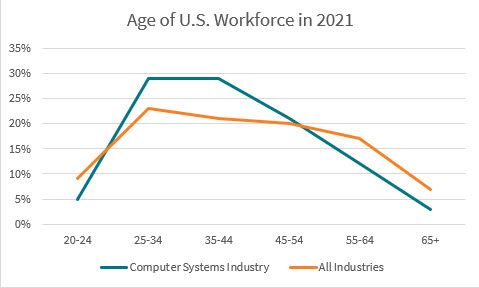
If you think that the U.S. technology industry skews young, you’d be right. The U.S. Bureau of Labor Statistics reports the median age for the U.S. workforce as a whole to be 42.2, whereas the median age for the Computer Systems Design and Related Services industry is a sprightly 40.7. The attitudes that different generations have toward their careers and workplaces are affected not only by their stage of life but also the cultural changes that have occurred during their lifetimes. To build a strong talent pipeline and retain top performers, technology leaders must foster company cultures that engage workers of all ages, no matter where they are in their career journeys. 

When I chart this median age data (as hc1 employees are known to do), it’s clear that the peak age range for tech workers is 25 to 44, a span that encompasses the Millenial generation, which is defined as those born between 1981 and 1996.

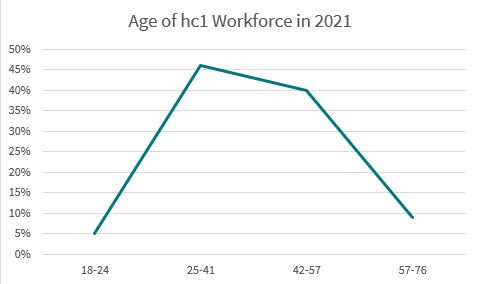
Millennials are only half the story when it comes to the tech workforce. The age span at hc1 shows nearly half of our employees are over 40, which includes Generation X,  born between 1965 and 1980; and Baby Boomers, those born between 1946 and 1964. About 5% of our workforce is from Generation Z, born after 1997. This number aligns with the nationwide number for our industry.

Entry-level Exploration

Most candidates for entry-level positions are likely to be Generation Z or young Millennials. What’s important to these job seekers? “It’s the purpose and the potential,” says Lori Smith, Senior Vice President of Talent at hc1. “They want to be able to grow their skills pretty quickly.” These candidates ask about on-demand learning, career development plans, access to leaders and mentors and stretch assignments. They want to go beyond what’s listed in the job description.

Executive assistant Tory Hungria and software engineer Zach Spitzer, leaders of hc1’s Young Professionals group (also known as the YoPos), echoed this idea when I asked them what was important to have at work in order to be successful. Tory spoke about wanting to connect to the company’s values, social responsibility and overall mission and vision. Zach valued having people throughout the company who were ready and willing to answer his questions and give context about why things are done a certain way. Tory agreed, saying, “It’s nice being in a culture where that’s okay, to have those questions and a questioning mindset, and, in fact, it’s celebrated.”

In addition to connecting to a broader purpose and learning opportunities, Generation Z wants to connect with each other. Zach and Tory surveyed their fellow YoPos about what they wanted the group to be, and the highest response by far was a social group.  “When you go directly from college to a new job, or you hop into a new job, it can be difficult at times to be able to try and connect with your other coworkers and your peers, particularly if you’re working remote. Being able to find a way to be able to bridge that gap is what we are hoping to do,” he said. 

Lori notes that if these needs aren’t being met, younger folks aren’t likely to stick around. Their drive to pursue their passions, expand their skills, make new connections, and achieve their own financial stability can lead them to develop other opportunities for themselves or find a completely different career path.

Mid-level Growth

Tech folks tend not to have long employment tenures, and demand for their skills remains high. Now that remote work has become the norm for technology jobs across the country, midwest companies like hc1 are having to compete with the higher salaries offered by tech companies on the West Coast. To prevent top talent from moving on, leaders need to regularly evaluate what they offer their employees in terms of pay, benefits and opportunities for advancement to make sure they are in line with others in the industry. 

A company of hc1’s size, with a fairly flat hierarchy, doesn’t offer a variety of management roles, but it does have the flexibility to empower managers to offer different avenues of access to employees who want to take their career to the next level. Employees may choose to deepen an existing skill set, take on different roles within their team or even move to a different team. For example, a senior developer might want to use the latest AWS offerings to solve a problem on a project, or a talent team member might take a course in career coaching and begin to offer that benefit to the entire company.

Experienced tech workers want to have autonomy in deciding where, when and how their work gets done. They are looking to have a healthy work-life balance with an employer that expects them to be accountable and awesome while they are at work but gives them the freedom to focus on their other responsibilities and enjoy their time away from work. 

Executive Adaptation

Given the amount of experience required, candidates for executive-level jobs are mainly Generation X or Baby Boomers. These candidates want to know what they’re getting into. They are likely to have questions about the company’s financial stability and 401(k) matches. They want to succeed in the role they have.

Once Boomers are brought on board, they are much more planted. They’re focused on using their expertise to build a legacy. They are not necessarily more loyal, but they are more likely to ride out difficult times, because this isn’t their first rodeo. However, executives have changed with the times as well, recognizing that the employer-employee relationship is now a partnership. Executives need to be proactive in getting feedback from employees about what they want from the workplace. Employees need to see that they are being listened to, or they will leave. 

Age and generation are, of course, just some of the factors that contribute to a person’s approach toward their job, career and work as a whole. Life circumstances, past experiences, values and personality all play a part, too. The fact that there is such a diversity of approaches to tech careers suggests that leaders who can personalize employee recruiting, engagement and retention efforts will be more successful. Even though Lori actively works to personalize the employee experience as much as possible, she points out that employees of all ages have the same core feelings when it comes to work. “People still want to have purpose. They want to feel like they’re making a difference, they’re having an impact and being respected. It’s really that simple.”

Curious about what hc1 has to offer? Visit our Careers page to learn more about available positions and apply.