By Mackin Bannon
Share

May 7, 2024

hc1 Workforce Optimization™ is a first-of-its-kind solution that leverages the power of artificial intelligence to help lab leaders make better, faster, more confident staff scheduling decisions. However, with such a novel product comes lots of questions: What is it? How does it work? Is this solution right for our lab?

Good news: we have answers to some of the most frequently asked questions about Workforce Optimization.

Q: Is Workforce Optimization a staffing / recruiting tool?
A: No, Workforce Optimization is a cloud-based software solution that uses artificial intelligence to predict demand for lab services and provide staff scheduling recommendations.

Q: Will I be able to use this as a replacement for my laboratory scheduling system?
A: No. Workforce Optimization is designed to work in tandem with your HRIS, such as Kronos, Workday, ADP, etc. It is not a replacement for these systems. The solution studies both your lab volume and HRIS data, then leverages artificial intelligence to project future volume trends, identify potential staffing shortages or overages and suggest specific, department-level resource adjustments.

Q: Do we need to have a large lab staff for this to be the right solution for us?
A: No. hc1 Workforce Optimization will provide powerful insights, recommendations and business impact regardless if you are a smaller, 50-person lab or a multi-site system with over 1,000 lab employees.

Q: Can we use this product across multiple labs? How does that work?
A: Yes! Many of our customers are multi-site. So regardless of how many performing labs you have, such core labs, satellite labs or hospital-based labs, you will be able to view all of them or filter down to a specific location to understand your staffing optimization.

Q: Which systems do you connect to?
A: We can connect to any LIS or HRIS – we have successfully interfaced with 80 unique systems! We started out as a company that built interfaces and became masters of healthcare data before developing the solutions that use it. If you can provide the data to us, our team takes care of the rest.

Q: Is it a problem if we have multiple LISs or multiple HRISs?
A: No. hc1 can combine multiple LIS data feeds through our hc1 Connect integration engine. Similarly, if you have multiple HRIS platforms, those data feeds can also be combined to get an enterprise-wide view in hc1.

Q: Can my team be notified if we have a specific staffing issue?
A: Yes! You can set up and customize email alerts to go out to specific team members when certain metrics are met or exceeded. This allows lab managers, leaders and executives to perform their day-to-day responsibilities, with the knowledge that they will be notified if there is a problem.

Q: Should I be concerned about leaving my lab staff scheduling decisions to AI?
A: Not at all! Workforce Optimization uses what we like to call “human-assisted” AI. While our machine learning model does make demand predictions and staffing recommendations, there is still a human element required to adjust staff schedules. The solution doesn’t automatically update staff schedules or communicate changes back to the HRIS. This gives you the opportunity to review each recommendation and ensure employees’ schedules are adjusted appropriately.

Interested in learning more about Workforce Optimization? Request a demo today to see how it can help you resolve staffing shortages before they happen by ensuring the right people are in the right place at the right time.

_____________________________________________________________________________

Mackin Bannon is the product marketing manager for hc1. Mackin held various roles covering nearly every marketing area before settling on product marketing as a focus and joining hc1 in 2022. During the workday, he enjoys bringing stories to life in clear and creative ways. In his free time, he enjoys following his favorite sports teams, collecting vinyl records and exploring Indianapolis.

By Mackin Bannon
Share

March 20, 2024

Clinical laboratories could be identified as the heart of any health system, as lab testing is the single highest-volume medical activity. However, labs are currently facing numerous threats that are placing a significant amount of stress on both organizations and lab professionals.

From staffing and supply shortages to higher costs and declining reimbursement, here are the top six trends putting clinical labs under stress.

Rising demand

Demand for diagnostic testing continues to rise, spurred by an increasing prevalence of chronic diseases and an aging population. In 2021, the Medicare program spent $9.3 billion on laboratory tests, marking a record 17 percent increase from the previous year. Noncommunicable diseases are widespread, particularly in the United States, where nearly 60% of adults live with at least one chronic condition. Globally, the aging population is also growing; the share of the global population aged 65 and older is projected to rise from 10% in 2022 to 16% in 2050. At that point, it is expected that the number of persons aged 65 years or over worldwide will be more than twice the number of children under age 5 and about the same as the number under age 12. In turn, the global clinical laboratory service market size is expected to expand at a compound annual growth rate (CAGR) of 3.2% from 2023 to 2030.

Higher complexity

Molecular and other advanced testing types firmly established a foothold in laboratories in response to the COVID-19 pandemic. Now that the value of PCR testing for infectious diseases has been widely recognized, laboratories are increasingly expected to expand the scope of their existing testing capabilities to include more analytes and observations. Demand for genetic testing is also increasing. By November 2022, U.S. physicians could choose from 129,624 genetic tests to order. These new tests can be highly complex and require new techniques, expensive reagents and equipment, as well as advanced skill sets. 

Lower reimbursement 

Labs may have more work to do but are getting paid less for it. They gained another year’s reprieve from significant Medicare reimbursement cuts as Congress delayed both PAMA cuts and a scheduled price data reporting period but saw drops in reimbursement from private payers as many took advantage of the 2022 rollout of the No Surprises Act to cut rates based on the newly visible pricing.

Higher costs 

Overall, market prices for lab supplies, equipment and labor are increasing. Lab equipment and IT software prices are projected to increase an average of 4.2% from January 2023 to December 2023, while reagent, energy and labor costs are also expected to increase. Clinical labor costs are projected to grow 6 to 10 percent in 2023-24, about three to seven percentage points above the prevailing rate of inflation.

Supply shortages

The COVID-19 global pandemic brought with it lasting effects on the U.S. healthcare system, including numerous supply chain shortages impacting the availability of collection devices, reagents and other critical lab supplies. While many supply chain issues have been resolved, warehouse and port capacity shortages, as well as logistics staffing shortages, continue to cause disruptions in many areas. Through the summer of 2023, the U.S. Food and Drug Administration’s Medical Device Shortages List continued to include numerous specimen collection devices, transport media, laboratory reagents and testing supplies.

Staffing shortages

A shortage of approximately 20,000–25,000 laboratory staff is severely impacting U.S. laboratories, with overall vacancy rates highest for chemistry/toxicology departments at 12.7%. Understaffing in the laboratory not only threatens turnaround time and quality, but also worker satisfaction. A 2023 Wage and Morale Survey conducted by Lighthouse Lab Services found that staffing levels and satisfaction were closely linked. Among the 67% of respondents who reported their labs were moderately or significantly understaffed, 41% described themselves as extremely or moderately unsatisfied in their role.

How can clinical laboratories overcome these issues while also improving patient care? Lab data. When labs combine their expertise with an effective technology strategy, they can proactively remove data silos and unlock the hidden value in lab data to optimize operations and inform testing and treatment decisions. Request a demo today to see how hc1 can help your lab extract invaluable insights from your data to solve your biggest challenges.

_____________________________________________________________________________

Mackin Bannon is the product marketing manager for hc1. Mackin held various roles covering nearly every marketing area before settling on product marketing as a focus and joining hc1 in 2022. During the workday, he enjoys bringing stories to life in clear and creative ways. In his free time, he enjoys following his favorite sports teams, collecting vinyl records and exploring Indianapolis.

By Mackin Bannon
Share

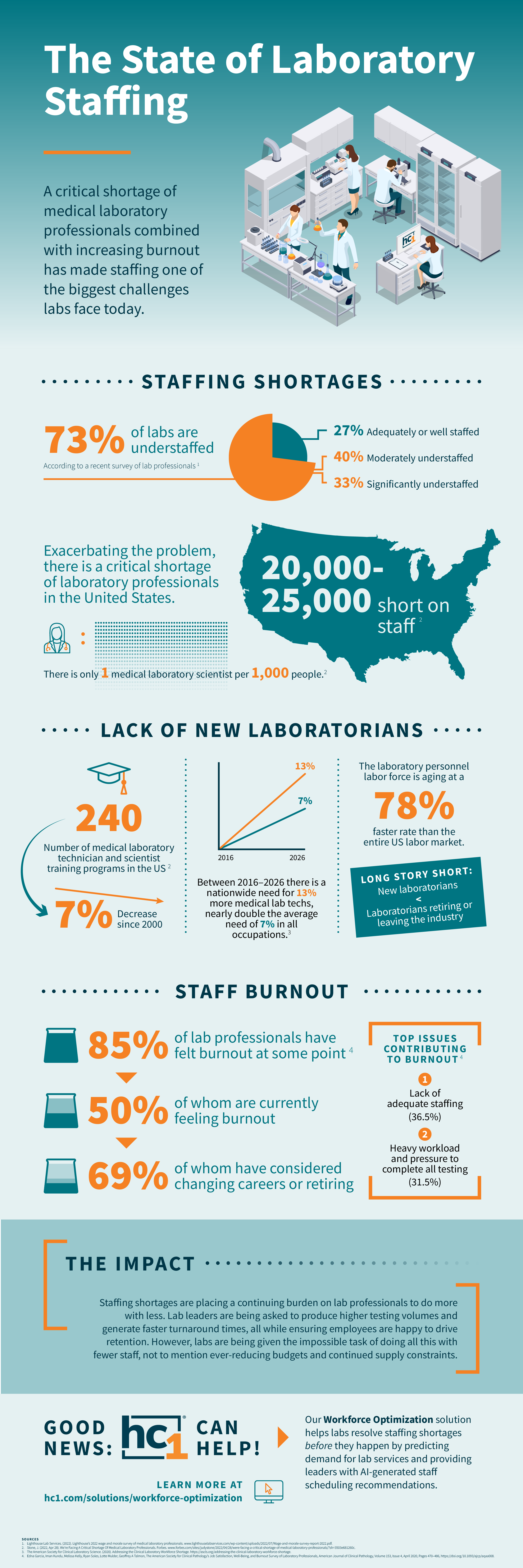
A critical shortage of medical laboratory professionals combined with increasing burnout has made staffing one of the biggest challenges labs face today. Several factors make lab staff scheduling difficult, including laboratory staffing shortages, a lack of new laboratorians, and staff burnout.

_____________________________________________________________________________

Staffing is one of the biggest challenges facing laboratories today. Over the last several years many labs have lost staff for a variety of reasons, from burnout caused by the COVID-19 pandemic to increasing rates of retirement. When combined with a declining number of training programs, the result is a critical shortage of medical laboratory professionals.

There are three primary factors contributing to this laboratory staffing challenge.

1. Staffing shortages

A 2022 Wage and Morale Survey conducted by Lighthouse Lab Services found that 40% of lab professionals indicated their lab was moderately understaffed, while another 33% described their lab as significantly understaffed. Just 27% of respondents felt their lab was adequately or well-staffed.

In total, this amounts to a shortage of approximately 20,000-25,000 laboratory staff across U.S. laboratories, or roughly one medical laboratory scientist per 1,000 people.

2. Lack of new lab professionals

One cause of these increasing lab staffing shortages is that the number of new laboratory technologists and technicians isn’t keeping up with the pace of those retiring or leaving the industry. The Bureau of Labor and Statistics “projects a nationwide need for a 13% average increase in medical laboratory technologists and technicians between 2016 and 2026, nearly double the underlying average increase in all occupations of 7%.”

A major factor is that the number of laboratory training programs is declining. There are approximately 240 medical laboratory technician and scientist training programs in the United States, a 7% drop from 2000, and some states have no training programs.

With the laboratory personnel labor force aging at a 78 percent faster rate than the entire United States labor market, it is critical that the lab industry finds a way to train current staff and increase the number of new laboratory professionals entering the market.

3. Staff burnout

A recent survey by the American Society for Clinical Pathology found that 85.3% of respondents reported having felt burnout as a laboratory professional. About half of those respondents that felt burnout reported this as a current issue, with 69.3% considering changing careers completely or retiring in response.

The top issues contributing to the burnout of laboratory professionals are lack of adequate staffing (36.5%) and heavy workload and pressure to complete all testing (31.5%), indicating a strong correlation between staffing shortages and burnout.

The impact

These staffing shortages have placed a continuing burden on lab professionals to do more with less. Lab leaders are being asked to produce higher testing volumes and generate faster turnaround times, all while ensuring employees are happy to drive retention. However, labs are being given the impossible task of doing all this with fewer staff, not to mention ever-reducing budgets and continued supply constraints.

The solution: hc1 Workforce Optimization™

The good news is that hc1 can help labs overcome these staffing challenges! Our Workforce Optimization solution helps labs resolve staffing shortages before they happen by using AI to predict demand for lab services and provide staff scheduling recommendations.

By predicting demand for lab services department-by-department across the organization, Workforce Optimization enables lab leaders to proactively identify potential shortages or overages, adjust staffing assignments accordingly and monitor the business impact of changes over time.

Interested in learning more about how Workforce Optimization? Request a demo today to discuss how we can work together to enable you to make better, faster, more confident staff scheduling decisions.

_____________________________________________________________________________

Mackin Bannon is the product marketing manager for hc1. Mackin held various roles covering nearly every marketing area before settling on product marketing as a focus and joining hc1 in 2022. During the workday, he enjoys bringing stories to life in clear and creative ways. In his free time, he enjoys following his favorite sports teams, collecting vinyl records and exploring Indianapolis.

By Mackin Bannon
Share

February 7, 2024

According to a report from the American Hospital Association, over half of hospitals ended 2022 operating at a financial loss, primarily due to hospital expense growth outpacing Medicare reimbursement by about 10 percent.

To combat these financial challenges, health systems are looking for ways to “launch new lines of business, add new services and find ways to differentiate,” according to Optum. Their survey of 150 healthcare leaders found that 49 percent consider growth one of the industry’s top challenges. 

“Hospital-based labs across the United States are forging ahead with their lab outreach services in ways that generate many benefits,” said Jane Hermansen, manager of outreach and network development at Mayo Clinic Laboratories, in an interview with Dark Daily.

Helping physicians deliver better care

Because of their community-based locations, health system and hospital-based labs can gain a superior level of trust with providers and patients. 

“Hospital laboratories are uniquely positioned to deliver value to the physicians and other providers in the towns and regions they serve,” said a recent Dark Daily article. “The obvious benefit is that the lab, its employees and its clinical pathologists all live in the community. They have professional relationships that may go back decades with the physicians who order medical laboratory tests for their patients.”

Additionally, many health system labs have available capacity and, due to being local, can turn around results faster. Often they can run tests and report results on the same day samples are received. Plus, when a hospital-based lab performs both inpatient and outpatient testing for a patient over years, providers can see their entire lab test history and gain a better understanding of that patient’s overall health.

Providing a competitive advantage

Health system labs can provide significant advantages to providers over external reference laboratories. In addition to the level of trust and fast turnaround times mentioned previously, hospital-based outreach labs can use their own lab data to provide additional value.

“When lab data is combined with patient demographics and other sets of data, an outreach laboratory can develop clinically actionable intelligence that helps physicians and health insurers improve patient care, while lowering the total cost of care,” said the aforementioned Dark Daily article. “When packaged correctly, these enriched data offerings can generate a new source of revenue for lab outreach programs.”

Having a robust analytics tool beyond what your electronic health record (EHR) or laboratory information system (LIS) is essential to delivering these types of insights. hc1 Performance Analytics™ connects your disparate lab data sources, such as LIS, billing and EHR, to deliver actionable, real-time insights via dashboards and reports designed specifically for the lab.

Emphasizing customer relationship management

Labs looking to grow their outreach programs will benefit from increasing focus on customer relationship management. Feedback on service quality, turnaround times and any issues that may arise will help enhance the partnership over time.

A robust operations and customer relationship management (CRM) solution integrated with the laboratory information system (LIS) using a real-time HL7 interface can provide the actionable insights and data necessary to target and engage prospects and service existing outreach clients. 

hc1 clients leveraging hc1 Operations Management™ and hc1 Performance Analytics™ have grown their outreach labs by as much as 90% in less than five years. Read this past hc1 blog post for five things contributing to their success.


Managing and growing a laboratory outreach program is essential to many health systems. Leveraging a robust operations and customer relationship management solution like hc1’s can provide valuable account health and client insights. Request a demo today to discuss how we can work together to grow your lab outreach program in the new year.

_____________________________________________________________________________

Mackin Bannon is the product marketing manager for hc1. Mackin held various roles covering nearly every marketing area before settling on product marketing as a focus and joining hc1 in 2022. During the workday, he enjoys bringing stories to life in clear and creative ways. In his free time, he enjoys following his favorite sports teams, collecting vinyl records and exploring Indianapolis.

By Lauren VanDenBoom
Share

January 24, 2024

Approximately 70 percent of medical decisions are based on pathology and laboratory test results.  Studies have shown, however, that 10 to 30 percent of the estimated 13 billion tests performed in the United States each year are either unnecessary or inappropriate. This over-testing leads to wasted cost and added hardship for the patient, who may also undergo excessive treatment as a result of inappropriate testing.

Health systems that are taking action to reduce the amount of unnecessary and inappropriate laboratory testing are saving millions of dollars.

Cleveland Clinic saved $5.9 million over eight years by avoiding more than 209,000 unnecessary tests. They were able to achieve these savings through automated notifications at the point of ordering. Their efforts included hard stop alerts to block repeat orders for tests that are never needed more than once in 24 hours and soft stop alerts that notify the provider when they are attempting to place a duplicate order and showing the previous results.

The University of Virginia Health System realized an annual savings of $61,524 on C. difficile testing alone after implementing a computerized clinical decision support (CCDS) tool to help clinicians determine the right time to order the right test. An internal audit prior to use of the tool showed that up to 67 percent of hospital-onset C. difficile infection cases did not have an indication for C. difficile testing.

Test Utilization is key to reducing costs

Between out-of-control healthcare spending and pressure to combat staff and supply shortages, health system labs need a simple way to reduce unnecessary, outdated, high-cost, low-value test orders.

The savings that can be realized through implementing an effective utilization program can more than compensate for the expense of putting the appropriate resources and team in place. Estimates project that healthcare systems could reduce costs of up to $5 billion per year if they were just to eliminate redundant tests.

Eliminate wasteful testing with hc1 Test Utilization™

Leveraging usage data and automated decision support greatly reduces unnecessary test orders and costs. However, data siloed across disconnected systems that don’t communicate well with one another can make test utilization improvement efforts a laborious and time-consuming process that lab leaders don’t have the resources to manage. 

hc1’s Test Utilization™ combines a comprehensive, customizable utilization engine with real-time insights to help labs reduce unnecessary, outdated, high-cost and low-cost value test orders. With a view into where and how often specific types of misutilization are occurring, lab leaders can target change across their organization and lower costs.

A few key features of hc1 Test Utilization that put the control in the hands of lab decision-makers are

Empowering labs to reduce waste and better utilize resources.


Shift from historical practice to best practice

Start from a core set of testing guidelines based on Choosing Wisely® recommendations, then customize them to fit your needs.

Ability to monitor utilization trends in real time

Uncover where and how often misutilization occurs to identify room for improvement and take targeted action.

Target and track the highest-cost testing

See which rules, types of rules, providers and locations are responsible for the most spending on unnecessary testing.

Driving change across your organization

Gain a clear view of ordering patterns throughout your organization, target change and monitor ordering behavior over time.

See how we can help you eliminate wasteful testing

Request a demo to see how hc1 Test Utilization can help your lab and health system save money!

_______________________________________________________________________

Lauren VanDenBoom, vice president of marketing at hc1 Insights, leads hc1’s marketing team in their efforts to advance awareness of hc1’s unique capabilities and vision. Lauren’s background includes more than 18 years of lab industry marketing and communications, including key marketing roles in toxicology and women’s health-focused laboratories.

By Mackin Bannon
Share

January 10, 2024

Healthcare organizations – especially laboratories – continue to experience rising costs year over year. These costs are driven by various factors, primarily staffing shortages, supply chain issues, increasing test complexity and general market forces like inflation.

How can labs combat these rising costs and ensure their operations don’t fall behind? Below are three strategies that can set labs up for success in 2024.

Reduce labor costs by optimizing staffing levels

Labor accounts for nearly half of health systems’ budgets and, according to the American Hospital Association, has increased more than 20 percent since 2019. Clinical labor costs are projected to grow 6 to 10 percent in 2023-24, about three to seven percentage points above the prevailing rate of inflation.

Further exacerbating the problem is the growing shortage of laboratory personnel. This shortage is due to several factors, including high educational costs; lack of familiarity with laboratory medicine as a career option, declines in the number of training programs and students trained; and high workload, stress and burnout.

One innovative way to both reduce turnover due to burnout and reduce costs associated with understaffing is to ensure lab staff scheduling is as efficient as possible. This can be done by predicting likely specimen volume in each department and then adjusting staffing levels accordingly. 

hc1 Workforce Optimization, our new cloud-based technology solution, uses artificial intelligence (AI) and machine learning (ML) trained on combined lab testing and HRIS data to recommend the most likely scheduling adjustments to create maximum efficiency. These actionable recommendations enable lab leaders to precisely schedule staff according to anticipated volume, reducing reliance on costly sendouts and travel techs.

Utilize excess analyzer capacity by bringing new testing in-house

Molecular and other advanced testing types firmly established a foothold in laboratories in response to the COVID-19 pandemic. Now that the value of PCR testing for infectious diseases has been widely recognized, laboratories are increasingly expected to expand the scope of their existing testing capabilities to include more analytes and observations. 

A 2022 survey by Medical Laboratory Observer uncovered that 54 percent of lab professionals had excess capacity in analyzers originally purchased to handle COVID-19 testing. This number is expected to continue increasing as at-home COVID-19 testing becomes the norm.

In response, 46 percent of those with excess capacity said they planned to add new tests to in-house offerings from among those that are currently sent out to reference labs, compared to just 10 percent that said they would retire some analyzers. Utilizing this excess capacity is a great way to draw more value from these capital investments while lowering the lab’s cost per test for tests brought in-house.

But how do labs determine which tests to bring in-house and what the financial impact will be? hc1 Sendout Management is an analytics tool that consolidates reference lab data into a single dashboard to provide real-time insight into reference lab performance and cost. With this data in hand, labs can assess specific sendout tests and make informed decisions based on reference lab performance and cost.

Improve laboratory stewardship to reduce wasteful testing

Improving laboratory stewardship will be key for value-based health systems in 2024. Leveraging usage data and automated decision support is proving to be highly successful in reducing unnecessary test orders and costs. The savings that can be realized through implementing an effective utilization program can more than makeup for the expense of putting the appropriate resources and team in place to do so. Estimates project that healthcare systems could reduce costs up to $5 billion per year if they were just to eliminate redundant tests.

One large, midwestern health system utilized hc1 PrecisionDx Advisor to launch a test utilization program across 12 hospitals, driving measurable, positive change. With real-time visibility and a clear focus for initial improvement, this health system was able to quickly compare utilization trends by site location, physician and several other attributes to bring issues and opportunities to light. Substantial reductions in the utilization rates of individual analytes at the hospital level were achieved within 15 months. 

Ultimately, the system-wide impact of these efforts was a 5.6% reduction in lab tests per patient per day, which amounted to 147,000 fewer unnecessary tests per year and a conservative cost savings of $383,000.

As laboratories look to address rising costs and other significant challenges facing the industry in 2024, hc1 is here to help. Our unique technology solutions help labs leverage their data to deliver superior outcomes. Request a demo today to discuss how we can work together to lower your lab’s costs and set your organization up for success this year.

_____________________________________________________________________________

Mackin Bannon is the product marketing manager for hc1. Mackin held various roles covering nearly every marketing area before settling on product marketing as a focus and joining hc1 in 2022. During the workday, he enjoys bringing stories to life in clear and creative ways. In his free time, he enjoys following his favorite sports teams, collecting vinyl records and exploring Indianapolis.

By Mackin Bannon
Share

December 15, 2023

hc1 offers a wide range of technology solutions that help labs of all shapes and sizes better leverage their data and improve operations. However, we recognize that each laboratory we serve has unique problems to solve and different ways to solve them.

hc1 prides itself on empowering clients to take a hands-on approach to customizing their solutions to fit their needs. Here are some of the ways that hc1 accomplishes that.

Personalized activation process

When a client purchases an hc1 solution they are partnered with an activation team dedicated to their organization. This group works alongside the client each step of the way to create a customized project plan that addresses the organization’s strategic objectives.

This plan can include simple items like customizing field and column labels or dashboard filters to more complex work like custom workflows and reports. Whatever the need, hc1 is dedicated to ensuring each client we bring on board is equipped with solutions that work for their organization and solve for their unique needs.

Continued enhancement through hc1 Service Select

Once a client is up and running, hc1 Service Select™ provides ongoing access to hc1 technical resources. Each new hc1 client receives a monthly allotment of hours as part of their agreement that can be used to expand or enhance their hc1 solutions at no additional charge. While other vendors typically charge an arm and a leg for custom work, Service Select offers clients hc1 experts on retainer to help maximize the value of their investment in hc1.

Clients have utilized Service Select to build custom workflows and rules, refine their analytics, create new reports and more. Clients with larger scale or more frequent projects can purchase additional Service Select hours if needed. Or, they can choose from hc1’s self-serve options.

Self-serve custom reporting with hc1 Data Toolkit

hc1 Data Toolkit™ enables organizations with staff experienced in data analytics to create and customize their own reporting and make changes as needed. This includes the ability to create custom data tables, design custom reports and data visualizations and report on hc1 data in third-party systems.

While other lab software vendors may offer self-serve tools, they’re often complex and require significant training. Our solution is easy to use and does not require expert programming knowledge. This empowers labs to self-serve if they wish rather than having to go through hc1 or other internal departments.

Take control of your lab operations with hc1

Don’t miss out on the opportunity to discover how our advanced analytics platform can help you leverage your data to drive results. 

Request a demo today and see for yourself how hc1 can empower your team to optimize operations, engage with providers, and make informed testing and treatment decisions.

___________________________________________________

Mackin Bannon is the product marketing manager for hc1. Before joining hc1 in 2022, Mackin held a variety of roles in marketing before settling on product marketing as a career focus. During the workday, he enjoys bringing stories to life in clear and creative ways. In his free time, he enjoys following his favorite sports teams, collecting vinyl records and exploring Indianapolis.

By Lauren VanDenBoom
Share

January 24, 2024

As we turn our sights to 2024, let’s look at what’s in store for labs this year. Spoiler: staffing shortages, AI, costs, outreach and data security make the list. 

Staffing shortages will continue to plague healthcare

In July 2023, a coalition of laboratory organizations submitted a letter to the U.S. Congress requesting action to address the growing shortage of laboratory personnel. The shortage is due to a number of factors including high educational costs; lack of familiarity with laboratory medicine as a career option; declines in the number of training programs and students trained; high workload, stress, and burnout. 

According to the letter, “Currently, most medical and public health laboratories suffer from significant personnel shortages, and many are operating at or near crisis mode. Staffing shortages now have the potential to undermine the ability of these laboratories to provide timely test results, which is imperative to both the public health and patient access to quality care.”

While the coalition urged Congress to include lab professionals in federal workforce programs they are currently ineligible to participate in, more and faster action will be needed to resolve the shortage by the end of 2024. 

Other recommendations to resolve staffing shortages can be found in this May 2023 Medical Laboratory Observer article, including

  • Investing in longer-term solutions to acquire, develop, and retain talent.
  • Training existing staff working in non-technical roles with a desire for more options. 
  • Reducing turnover through professional development programs.
  • Innovation. 

One innovative way to reduce turnover due to burnout and reduce costs associated with short-term staffing solutions is to ensure lab staff scheduling is as efficient as possible. This can be done by predicting likely specimen volume in each department and then adjusting staffing levels accordingly. hc1 President Michael Braverman recently shared in MedCity News that “once time is lost, you can never get it back. Real-time insights enable laboratories to be more proactive, strategic, and responsive in managing their staffing needs and mitigating the impact of market forces affecting labor shortages. By using data to guide decision-making, labs can foster a stable and productive workforce, even in the face of dynamic market conditions.”

hc1 Workforce Optimization, which will become available to all laboratories in early 2024, uses Artificial Intelligence (AI) and Machine Learning (ML) trained on combined testing and timekeeping data to recommend the most likely scheduling adjustments to create maximum efficiency. American Oncology Network (AON), a rapidly growing network of community-based oncology practices nationwide, will be the first to use the solution. 

“Lab results have downstream implications for our providers and patients,” said Curtiss McNair, VP of laboratory services for AON, in a press release announcing hc1 and AON’s development partnership in June 2023. “This partnership enables us to develop better processes with real-time actionable insights into our data and imparts us with forward-thinking recommendations based on a detailed analysis to optimize staffing and expenses,” McNair added.

Laboratories will find more innovative ways to use AI 

Through solutions like hc1 Workforce Optimization, AI will be used to create efficiencies and help offset staffing shortages. Other uses for AI in the lab include recognition of patterns in images, such as whole slide pathology imaging, cell-based imaging and breast cancer screening.

For laboratories to expand their use of AI, they will need to address data storage and complexity issues first. To facilitate the move toward AI/ML, Medical Laboratory Observer says that “if we consider a wider scope and complexity of data sources, this raises significant challenges from the technical issue of aggregating vast datasets obtained from diverse sources to the crucial human aspect of securing consent for personal data usage and safeguarding privacy.” 

Overcoming these challenges is entirely possible and worth the effort, as Melody Boudreaux Nelson, DCLS, MS, MLS(ASCP)CM wrote in Medical Lab Management in March 2023, “For the medical laboratory, AI adoption offers a unique opportunity—a traceable “70%” (or greater) contribution to medical decisions. “

According to hc1 VP, Data Strategy, Chuck Girard, “Encouraging innovation within laboratories drives advancements in diagnostic techniques, technologies, and treatment methods.“

He said, “Labs must consider what they’ll need to do to be good partners to the health systems and providers that they serve as they pursue innovation. One way of doing that is to find technology partners that can help them manage and curate the lab’s data to better support clients’ needs. A good partner will not only offer best-in-class technology, but will pair it with deep subject matter expertise in the lab space. The partner will know what makes lab data challenging to work with and will offer technology solutions that overcome those challenges to optimize the lab data for innovative AI/ML-driven use cases.”

Healthcare leaders will invest more in cybersecurity

With the increasing volume of data being generated by healthcare, data security will be a continuing concern in 2024. Becker’s Health IT reporting on a recent Guidehouse analysis noted the top IT investment for 2024 is projected to be cybersecurity at 55%. 

The planned investment increase in cybersecurity spending signals that healthcare systems are taking the need for more protection against threats like ransomware attacks and data breaches seriously. In August 2023, Medical Economics reported that 327 data breaches had been reported to the U.S. Department of Health and Human Services’ Office for Civil Rights so far, a more than 104% increase over the prior year. Data of more than 40 million individual patients was involved in cyberattacks by August 2023, a 60% increase year-over-year.

According to Chris Toth, director of compliance and risk management at hc1 Insights, “The security of all data is not something to be taken lightly and regardless if it is customer or patient data, it should be encrypted from cradle to grave as it takes the guesswork out of it. As cybersecurity threats continue to emerge, health IT leaders need to demonstrate that their organization takes not only data security and privacy but risk management seriously.” 

hc1’s own investment in achieving HITRUST Risk-based, 2-year Certification demonstrates to our customers our commitment to the highest standards for data protection and information security. Watch this video to learn more about how and why hc1 chose to pursue HITRUST Certification. 

Rising costs will continue to be a concern

Staffing shortages and inflation have certainly led to increases in labor and supply costs for laboratories and are unfortunately expected to continue. 

Labor accounts for nearly half of health systems’ budgets and, according to the American Hospital Association, has increased more than 20 percent since 2019 and clinical labor costs are projected to grow 6 to 10 percent in 2023-24, about three to seven percentage points above the prevailing rate of inflation. 

Meanwhile, lab equipment and IT software prices are projected to increase an average of 4.2% in 2023, while reagent, energy and labor costs are also expected to increase.10

In addition, labs are finding that more complex testing leads to the need for new instruments and continuing education for technicians. Molecular and other advanced testing types firmly established a foothold in laboratories in response to the COVID-19 pandemic. Now that the value of PCR testing for infectious diseases has been widely recognized, laboratories are increasingly expected to expand the scope of their existing testing capabilities to include more analytes and observations. Demand for genetic testing has also increased. By November 2022, U.S. physicians could choose from 129,624 genetic tests to order. These new tests can be highly complex and require new techniques, expensive reagents and equipment, as well as advanced skill sets. 

Optimizing use of resources will be one key way labs will be able to lower costs in 2024. Automation and AI will also have a role to play in lowering costs, as well as improving efficiency in billing so as to avoid unnecessary write-offs

Improving laboratory stewardship will be key for value-based health systems. Leveraging usage data and automated decision support is proving to be highly successful in reducing unnecessary test orders and costs. The savings that can be realized through implementing an effective utilization program can more than make up for the expense of putting the appropriate resources and team in place to do so. Estimates project that healthcare systems could reduce costs up to $5 billion per year if they were just to eliminate redundant tests.

One large, midwestern health system utilized hc1 PrecisionDx Advisor to launch a test utilization program across 12 hospitals, driving measurable, positive change. With real-time visibility and a clear focus for initial improvement, this health system was able to quickly compare utilization trends by site location, physician and several other attributes in order to bring issues and opportunities to light. Substantial reductions in the utilization rates of individual analytes at the hospital level were achieved within 15 months. Ultimately, the system-wide impact of these efforts was a 5.6% reduction in lab tests per patient per day, which amounted to 147,000 fewer unnecessary tests per year and a conservative cost savings of $383,000.

Healthcare systems will increase focus on laboratory outreach

In an effort to offset costs, healthcare system laboratories will also look to expand their outreach programs. According to a report from the American Hospital Association, over half of hospitals ended 2022 operating at a financial loss, primarily due to hospital expense growth outpacing Medicare reimbursement by about 10 percent.

To combat these financial challenges, health systems are looking for ways to “launch new lines of business, add new services and find ways to differentiate,” according to Optum. Their survey of 150 healthcare leaders found that 49 percent consider growth one of the industry’s top challenges. “Hospital-based labs across the United States are forging ahead with their lab outreach services in ways that generate many benefits,” said Jane Hermansen, manager of outreach and network development at Mayo Clinic Laboratories, in an interview with Dark Daily

Health system lab outreach programs can offer several benefits because of their community-based locations, available capacity and ability to often turn around test results faster than a lab outside the area. 

Labs looking to grow their outreach programs will benefit from increasing focus on customer relationship management. Feedback on service quality, turnaround times, and any issues that may arise will help enhance the partnership over time.

A robust operations and customer relationship management (CRM) solution integrated with the Laboratory Information System (LIS) using a real-time HL7 interface can provide the actionable insights and data necessary to target and engage prospects and service existing outreach clients. 

hc1 clients leveraging hc1 Operations Management™ and hc1 Performance Analytics™ have grown their outreach labs by as much as 90% in less than five years. Read this past hc1 blog post for five things contributing to their success.  

Bonus Prediction: Lab industry growth in 2024 is inevitable

The global clinical laboratory service market size is expected to expand at a compound annual growth rate (CAGR) of 3.2% from 2023 to 2030.  Demand for diagnostic testing continues to rise, spurred by an increasing prevalence of chronic diseases and an aging population. Noncommunicable diseases are widespread, particularly in the United States, where nearly 60% of adults live with at least one chronic condition. Globally, the aging population is also growing and will likely need increased care and testing in the coming year. The share of the global population aged 65 and older is projected to rise from 10% in 2022 to 16% in 2050. At that point, the number of persons aged 65 years or over worldwide is expected to be more than twice the number of children under age 5 and about the same as the number under age 12.

As labs look to address the challenges presented by this increase in demand with fewer resources, hc1 is ready to help. We aren’t just delivering technology solutions for laboratories. We’re empowering healthcare to make people healthier. We get to know our clients and what they need and work with them to continuously innovate with lab data. Request a demo to discuss how we can work together to solve your lab’s challenges.

_______________________________________________________________________

Lauren VanDenBoom, vice president of marketing at hc1 Insights leads hc1’s marketing team in their efforts to advance awareness of hc1’s unique capabilities and vision. Lauren’s background includes more than 18 years of lab industry marketing and communications including key marketing roles in toxicology and women’s health-focused laboratories.
By Tawni Reller
Share

December 6, 2023

Laboratories and health systems track many aspects of their processes and business performance using data such as quality metrics, key performance indicators, test utilization, and individual performance. These measures are commonly presented in an analytic fashion, where data is aggregated over time and presented in a useful way (inclusive of comparison against historical performance). It’s fairly easy to look at a single entity and state “Yes, it’s going well” or “No, this requires intervention” when comparing it to a predetermined expectation or historical data. But how does an individual’s data or independent data point transition into larger perspectives like a department, specialty, hospital, or health system? And how do you know if your lab is the best in the business or has room for improvement? That’s where benchmarking comes into play. 

What is Benchmarking?

Benchmarking has been a buzzword in laboratories and health care overall for a while. People hear it and nod enthusiastically, exclaiming, “YES! We want to do that, too!” As is typical with buzzwords, they often mean different things to different audiences, making it difficult to determine if a conversation around benchmarking as a construct is, at its core, the same among participants. For the purposes of this article, the definition of benchmarking will be to evaluate (something) against specific criteria that have been vetted, documented, and measured by an organization and the outcome(s) compared to an organization that is considered ‘the best in the business.’ 

Let’s clarify that definition a little further. ‘Vetted’ relates to the (something) that is being carefully examined, has value, and is specifically defined. “Documented” relates to why the benchmark of the (something) is important and how it was benchmarked. “Measured” refers to how the benchmark is assessed or valued in support of other entities comparing their data to it. 

How do benchmarking and common operational metrics differ?

Benchmarking differs from common operational metrics in that quality metrics or key performance indicators are measured against a predefined lab or facility expectation (which could be an agreed-to standard or be defined by a service level/interdepartmental service agreement). These thresholds may vary across labs within a health network due to department structure (STAT lab in the ED vs. ED work sent to the main lab), facility type (critical access hospital vs. academic medical center), or testing services provided (performed in-house or sent to another facility in the health network). Whether the predefined expectation is “the best in the business” instead of “acceptable” is not considered. 

Another difference between benchmarking and operational metrics is that operational metrics are simply a comparison to answer a straightforward question: are we meeting (or exceeding) an expectation or not? It has no insight into “what the best case scenario is and how we evolve to perform in the best way possible.” Done well, that is what benchmarking accomplishes.

Benchmarking takes the concept of operational metrics further, looking at the “best of the best” – where exceptional excellence exists in a comparable environment – moving into the territory of identifying areas of improvement, implementing a plan to support improvement, and continuously analyzing the outcomes throughout the process. (So it’s similar to developing quality indicators to measure process improvement, but often the scope is different and there may be no specific declaration of ‘complete’.)

Are quality metrics the same as benchmarking?

Quality metrics to analyze performance-related analytics are a simpler concept  to benchmarking and systems, such as hc1 Performance Analytics and PrecisionDx  (PDx) Advisor, support those needs very well. Analytics do not require the depth that benchmarking requires, but they may be a component of the benchmarking process. Understanding how your organization (lab, hospital, etc.) performs is a first step in preparing to benchmark data internally (within your own health network or system), and understanding your internal benchmarking will feed external benchmarking initiatives (anonymous comparison of your benchmarks to a valid, “the best of the best” center of excellence, along with similar organizations who are comparing to the same benchmark).

How can a lab get started with benchmarking?

With benchmarking being a continuous process of comparison of your organization against “the gold standard,” opportunities for improvement often require a committee-type structure to enable learning and adopting best practices learned from the “best of the best” organizations. Benchmarking may be a logical ‘next step’ from a lab stewardship perspective, where the lab already has an understanding of related processes and implemented stewardship-related changes to support best ordering and testing practices within their health system. 

Click here to learn more about strengthening or starting a Lab Stewardship program.

By Lorri Markum
Share

November 30, 2023

The facts are…

  1. Lab testing is the #1 utilized medical benefit.
  2. The volume of tests being sent to labs is increasing, but adequate staff to perform the testing is scarce.

The result? Lab managers are being challenged to do more with less.

Lab leaders and managers nationwide know the challenge of being asked to improve performance, do more and meet goals with fewer resources and staff. Though a steady volume of tests entering clinical labs and health systems is necessary for patient care, not having the proper resources to avoid high levels of staff burnout and a lack of staff retention is creating a breaking point for lab managers. According to the 2023 Lab Trend Report, more than 14 billion clinical laboratory tests are performed each year, making it the number one utilized medical benefit. So, what’s the solution? 

Labs are looking to their data for answers


hc1 recently presented a webinar on
Doing More With Less – How labs can better utilize their data to drive superior outcomes, where Directors of High Value Care, Dawn Seymour and Adam Sajewich shared what some hc1 lab clients have done to overcome their biggest challenges. Through an interactive multiple-choice poll during the webinar, participants were asked what they are expected to do more of while having fewer resources in their labs. The top results were:

  1. Increasing testing volume despite staffing shortages.
  2. Improving test utilization without insight into order habits.

The key to resolving these challenges lies within something every lab has at its fingertips but can’t fully access the true value of––Data. The complexity of lab data prevents many labs from extracting its full value. The data is oriented around a specific observation during a single encounter and combined with qualitative clinical input. This makes viewing the data in a meaningful way in aggregate, across multiple encounters or over time very difficult. Leveraging this powerful resource to its fullest extent requires a dedicated and knowledgeable team to extract its insights.  

Real-time visibility into test utilization helps reduce waste and improve care


Unnecessary medical care contributes billions of dollars annually to healthcare spending in the United States. A critical look at lab ordering across a network can potentially garner millions of dollars in hard cost savings.
hc1 Test Utilization™ helps hospital labs reduce unnecessary low-value and high-cost tests to improve patient care and reduce costs. hc1 Test Utilization evaluates orders in real-time and accounts for diagnosis, location, specialty medications, demographics and more. 

A case study from a 12-hospital health system showing how they achieved positive, measurable change through real-time visibility, data-backed insights and actionable metrics using hc1 Test Utilization was shared during our Doing More with Less webinar. System-wide, they achieved a 5.6% reduction in lab tests per patient per day, which amounted to 147k fewer unnecessary tests per year and a conservative cost savings of $383k per year with just ten clinical guidelines set within the solution. This client success story is one we are very proud of.

Real-time insights fuel outreach growth and overcome disconnected, disparate systems


Other areas of concern voiced by lab leaders were addressed during the
webinar, such as outreach growth and the struggle labs experience because their data and processes are scattered across various disparate systems that are disconnected and unable to communicate with one another. “Because I’m 99% certain that all of us don’t fully understand the capabilities of lab data because of the source system limitations, we’ve architected hc1 solutions from the ground up for laboratories with design first principles that contemplate the multi-dimensional nature of lab to remove these limitations,” Sajewich said, “Not only are we able to provide an intuitive experience, but we can automate workflows and reporting from the platform. You can set thresholds to receive alerts if turnaround times spike above your expectations or you’ve been hit with a volume spike and need to adjust staffing levels to accommodate. We show you where to focus based on what we see within the data your lab generates.”

AI-generated recommendations help to optimize staffing levels to reduce burnout proactively, lower labor costs and improve lab operations

hc1 Workforce Optimization is the most recent addition to the hc1 portfolio and was highlighted during the webinar. Workforce Optimization addresses one of the most significant issues labs face today: adequate staffing. With 67% of labs nationwide experiencing employee understaffing, burnout and turnover are among the most prevalent consequences of consistent understaffing. This can also lead to missed benchmarks and increased turnaround times, negatively impacting patient outcomes.

Workforce Optimization combines lab volume and timekeeping data in a single platform and then utilizes machine learning and AI to create a data-driven strategy that provides actionable recommendations with high-level visibility on where to proactively optimize staffing levels by location, lab department and time of day. All of this helps retain employees, reduce costs and elevate patient care.

Built to help labs succeed

We’re working to close the gap between data and taking action.

hc1 has been helping IDNs, academic medical centers and the largest commercial labs in the world overcome their top challenges for over a decade. Are you ready to learn how to elevate your lab, resolve your staffing challenges, and attain your goals?

To learn more about the aforementioned info and the tangible next steps you can take to capitalize on your data, watch the webinar Doing More With Less on-demand by clicking here and be empowered to conquer your lab’s needs.

__________________________________________________________________________

Lorri Markum is the marketing manager for hc1 Insights and has over two decades of corporate and nonprofit marketing leadership experience. Lorri specializes in B2B marketing and SEO optimization. Before joining hc1, she was the marketing manager for a nonprofit healthcare organization serving 40 counties throughout Indiana.