By Lauren VanDenBoom
Share

April 14, 2020

hc1, in partnership with Quest Diagnostics, is featured in a new education and thought leadership site from AWS.  

Launched to fill the gap left by the cancellation of the HIMSS20 Conference due to COVID-19,  the AWS at HIMSS20 Web Experience delivers education and thought leadership to help transform global health in the midst of this pandemic.  

Unlocking Precision Medicine in the Cloud” presenters, Zach Berg (hc1) and Erin Monteverdi (Quest Diagnostics), discuss how lab data can lead the way to value-based care. The presentation dives into a problem faced by many labs, the massive costs associated with wasteful spending contributed by low-value care. The team offers a visual explanation of how Quest Lab Stewardship® powered by hc1 uses AWS to help identify unnecessary testing in order to reduce wasteful spending. 

The AWS at HIMSS20 Web Experience currently features 20+ hours of digital, on-demand content originally developed for HIMSS20 and updated in places with COVID-19 relevant material. The sessions are led by AWS APN partners alongside experts who will highlight their ability to create value by providing solutions to some of healthcare’s biggest challenges. 

In 2016, hc1 achieved AWS Partner Network Healthcare Competency status, one of the first within the AWS partner ecosystem to achieve this level of recognition. As both an AWS Healthcare Competency and Advanced Technology Partner, hc1 provides the highest level of architecture quality, scalability, and reliability to manage enterprise workloads. By leveraging AWS services through hc1, laboratories, and health systems gain a cloud platform optimized for performance, scalability, and security—essential elements to a successful value-based care delivery model.

By Lauren VanDenBoom
Share

November 11, 2020

Healthcare is hard. A colleague of mine succinctly describes with two words our current problem in our care delivery system: overwhelming complexity.

If you work in or around healthcare, you know this to be true. Unfortunately, it is not getting any better either. Consider what we are seeing in the headlines over the last 10 months related to COVID-19. The virus completely overwhelmed our health systems in short order, because of the adversarial nature of interoperability that exists in health and public health in the United States. 

We have struggled greatly to manage the spread of the virus and treat the patients flooding into our care delivery system in 2020, because care components operate independently of one another. The COVID-19 struggle has exposed many deficiencies of technology we have invested billions in annually–all in an effort to better treat and manage disease in America.


Why haven’t we treated and managed this crisis better?

It is easy to point fingers at the leadership at different levels of our public and private health systems in how they have managed this pandemic. Yet, there was a greater fundamental issue at play long before we found our country in this current crisis.

The information needed to help predict and prevent the spread of COVID-19 in our communities and understand the capacity of our local hospitals and health systems to treat patients is locked away inside medical records and lab information systems.  

We have built a sophisticated system over the last decade of capturing information as we have transitioned from paper-based records to electronic medical records and lab information systems. 


The cost of care continues to grow out of control. 

As a patient, we should expect services that cater to our individual needs. Instead, we pay more than almost any other country in the world for a system that operates under a one-size-fits-all, trial-and-error model that wastes $765 billion annually. This care is riddled with missed diagnoses, protracted illnesses, and premature death that is preventable given all the information available.

The human toll is even more devastating. More than 128,000 people in the U.S. die each year from simply taking their medications as prescribed—four times the number of people killed by prescription painkillers and heroin combined. 


Precision medicine holds promise as the solution to healthcare’s fundamental flaws. 

With a single lab test, physicians have information on a patient’s genetic markers, which they can use to determine which treatments will work best and carry the fewest risks for that individual. Yet adoption of precision health remains limited to very narrow patient cohorts like oncology and cardiology. Why is that?

The blame for the lack of adoption of precision health—and healthcare’s flaws in general—is multifaceted. The information clinicians need to deliver personalized, precise care is locked away in disconnected databases, buried in medical journals, and isolated in multiple patient data silos. 

Plus, broken incentives continue rewarding quantity over quality, as evidenced by the billions of dollars in government subsidies and incentives targeting broad implementation of electronic health record (EHR) systems that nonetheless failed to deliver access to meaningful clinical insights. We need precision health.


What is precision health? 

Precision health as defined by UCLA Health “takes into account differences in people’s genes, environments, and lifestyles and formulates treatment and prevention strategies based on patients’ unique backgrounds and conditions.”.

We are all unique yet our healthcare system is designed to treat everyone the same. This one-size-fits-all model can have adverse consequences for your health if you are not the average patient who responds to a particular treatment or prescription as expected. 

There is a reason pharmaceutical companies and retail stores provide a laundry list of side-effects when you fill a prescription or see a commercial about a drug. Our bodies respond differently because we are not all average. 

UCLA Health further defines the goals and benefits of precision health care tailored to both providers and patients as giving “the medical team the tools to better understand how complex the human body is. Precision health will help us to keep you healthy. If you do get sick, precision health will help us understand which treatments work best with the fewest side effects.”

 Keeping patients from getting sick has additional benefits. It can reduce the burden on our care providers who are suffering from staggering levels of burnout. It can lower the costs of care for patients by ensuring they are on the right treatments the first time. Precision health improves the quality of care for everyone involved.

We need to unlock the full value of precision health if we have any hope of reducing variations in care, addressing health disparities, and lowering and controlling growing costs to deliver quality care.

The CDC highlights the value of precision health in not only our ability to diagnose and treat patients, but also this approach to care “can better predict, prevent, treat, and manage disease.” 

Everyone wants to treat and manage the diseases impacting patients that are needing sick care in our delivery system. If we can prevent and predict it before they get sick, that is infinitely better. What will it take to get there with healthcare?


Critical Insights, Analytics, and Solutions for Precision Health

Over 2.3 trillion gigabytes of data are generated every year in healthcare. Equal to: 

All the data is almost useless without a method to ingest, organize, and normalize it into actionable information that is meaningful for providers and patients. Healthcare professionals require streamlined insights to break through the noise in each  7-minute patient visit. 

Precision Health is one of the many silver bullets that has the potential to cure what ails our current U.S. health systems. 


Precision Health is powered by more and more data 

We have networks that provide our news and entertainment that leverage our interests to suggest information and programming we would find valuable–saving us time and not wasting money on things we would not. We have complex networks that tie together our social and work relationships. Without networks of independent banks working together, we all might be socially distancing at our local branch with masks on trying to perform financial transactions. 

Healthcare is the last industry to embrace digital transformation to improve the lives of the people who depend on it and those professionals who work inside our care delivery system. We are seeing huge strides in financial technology that enable safety and security for our financial assets, but not in healthcare for our physical and mental assets.

Why can’t we have secure networks that work together in healthcare?

We can.

The rapid advances in secure cloud technologies powering machine learning, artificial intelligence, and big data in financial services, is available and emerging in precision health and healthcare. 

A new category of Precision Health Insight Networks (PHINs) is making this possible for organizations of all sizes in healthcare who are responsible for managing complex patient information securely across networks. These PHINs provide critical insights, analytics, and solutions for precision health with ever-faster time to value.
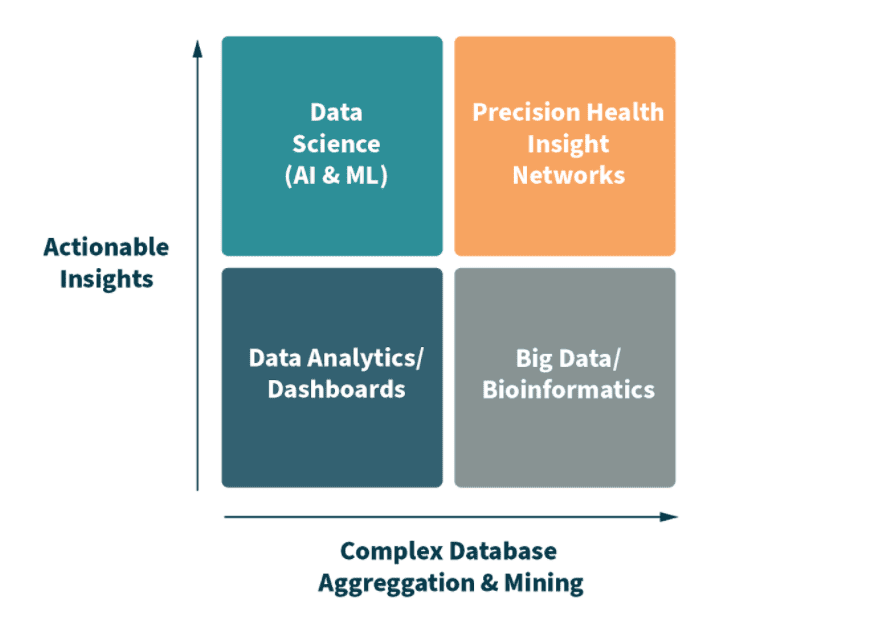
PHIN

The beauty of PHINs is they take the stress of wasteful practices out of the system and off the providers who are critical to help usher in this new era of personalized, high-value care everyone can benefit from and embrace—profitably improving patients’ lives through value-based care by identifying and connecting data to the delivery of high-value care.

We have all heard the stories of systems that have invested in data lakes and enterprise data warehouses that have not produced the meaningful and actionable insights promised. Can we all agree that most health systems, providers, and payers simply lack the expertise to securely ingest, organize, and normalize new and expanding data sets in real-time to drive better decision making and improve health outcomes? The cost and effort to maintain the data is growing out of control.

It is incredibly discouraging for our healthcare system to have so little to show after gathering trillions of gigabytes of patient data without usable and meaningful insights. 

We’re asking our caregivers to perform an impossible task in our data-rich world. Without the insights provided by precision health, having all of the practice-changing evidence and data sets in the world becomes futile–leaving administrators frustrated and care providers exhausted trying to keep up with complex volume-based models to remain profitable.

New insight networks for precision health solve these complex problems by transforming live data into valuable and actionable healthcare insights much like ATMs did in banking to give you valuable information for your financial assets. PHINs are helping patients and families make it out of the $17 billion healthcare delivery system unscathed by avoiding costly and harmful adverse events.  

Experts in Precision Health Insight Networks (PHINs) deliver on precision testing and prescribing for mass personalization that the old-school, volume-based, fee-for-service care models will never achieve. 

There simply is no room for these status quo models that deliver ineffective, harmful trial-and-error and costly, one-size-fits-all care that varies wildly from facility to facility. 

Now is the time to invest in Precision Health Insight Networks for high-value care. They deliver insights our healthcare leaders and providers can take action on with precision–the right patients, right tests, and right prescriptions. All right now.

These advances in healthcare from PHINs are occurring at the intersection of Digital Transformation, Personalized Medicine, and Population Health today.
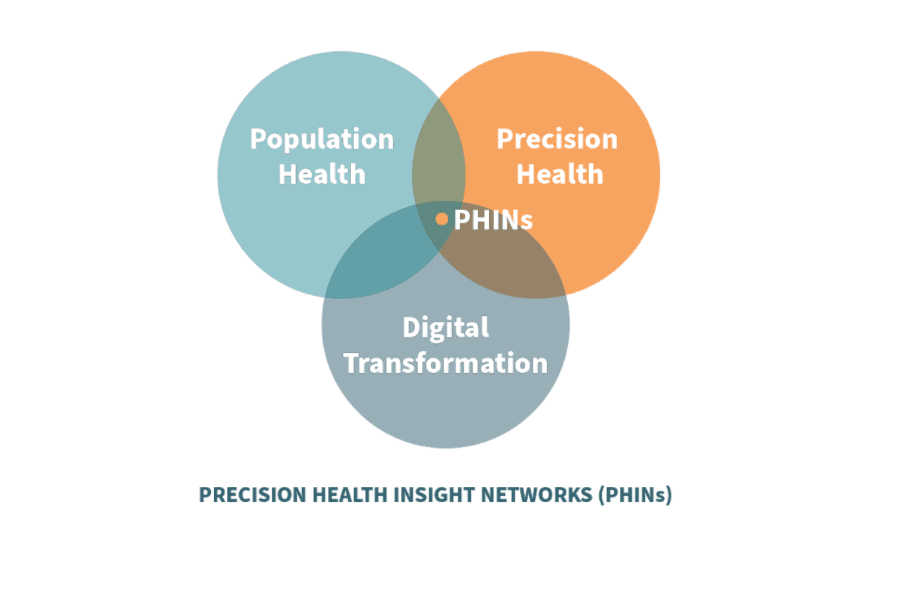
precision health insight network

This emerging category of solutions holds tremendous promise to deliver countless breakthroughs that will forever change the way healthcare is delivered, saving millions of lives and billions of dollars.


hc1 powers Precision Health Insight Networks (PHINs)

The hc1 Platform™ is crafted to address the problems with precision health today. The Platform is purpose-built to ingest, normalize, and organize disparate healthcare data at scale; infinitely expandable, immediately accessible, ultra-high availability on the AWS cloud stack. We are the company behind the emerging category PHINs, a topic we will explore in-depth during the Precision Health Virtual Summit with Becker’s and our partners AWS and Quest on November 16-17.


PHINs in action

Everyone knows what happened in the United States during March with COVID-19. All businesses were impacted by the simultaneous national shutdown. A number of businesses decided to furlough employees immediately and wait it out. Others went into action to help. Our CEO Brad Bostic chose to make a difference–by utilizing our technology stack and our lab relationships to help flatten the curve. Within weeks, we had formed a coalition of lab and technology partners, including AWS, to deliver a lab testing dashboard to aid in the fight against the spread. 

On April 3, CV19Dashboard.org was made available to frontline workers in healthcare and government with data from over 20,000 lab ordering locations. At the time, much of the data was locked away in case reports that came in as much as 8-14 days in arrears and riddled with errors. Our anonymized dashboard was near-real time with lab results directly from the sources of testing activity. It evolved to provide a real-time Local Risk Index (LRI) that showed leaders where hotspots of virus activity were trending around the US and in local communities. We even built a special version of the LRI county map for Dr. Scott Gottlieb and AEI.org that has had over 100K users since May 1. The hc1 team won awards and recognition for our response to the global pandemic. This coordination and collaboration across labs does not happen without PHINs built on top of outbreak signal solutions powered by AWS. We accomplished in weeks what would have taken others months, if not years, to pull together. 

Other solutions were spawned from this insight network solution for COVID-19. A great example is our solution for the state of Arizona with our partner Sonora Quest for their most vulnerable populations in Long-Term Care (LTC) facilities. It was a solution that provided a command center for employees and patients to monitor testing and the spread of the novel coronavirus. Arizona was lauded as a model state for how they addressed the crisis around testing and overcame issues related to data reporting. Our team helped make that happen.

Employers looking to get back into the office or back to campus, now have hc1 Workforce Advisor™ as well, to help them manage through this ongoing pandemic. Like the LTC solution, we have partnered with organizations in lab testing, as well as contact tracing app providers, to integrate our lab testing data, command center, and local risk insights for a full suite employer solution to help employees return with confidence.

Is your organization ready to deliver safe, effective, affordable, and personalized care?

Start by connecting data to delivery with better health outcomes.

By Lauren VanDenBoom
Share

hc1 and Becker’s Healthcare have partnered to bring together leaders in precision medicine for a free, two-day, special virtual event on November 17-18. The Precision Health Virtual Summit will focus on the changes our care delivery system needs as it transitions from fee-for-service to value-based care reimbursement models. Plus, public health leaders will share how the pandemic, as well as political and civil unrest, are impacting healthcare today for patients, providers, payors, and employers. 

Registration is open now at www.hc1.com/summit

Every patient down to their very own genetic makeup is unique. So why are we still treating everyone the same? The one-size-fits-all, trial-and-error healthcare model results in missed diagnoses, protracted illnesses, and even premature death.This outmoded approach also wastes $765 billion annually.

The answer to the problem – Precision Healthcare. When we start treating patients as individuals we deliver improved care and financial performance together. We’re bringing together leaders in the field of precision health to share how they’re solving precision health without budget-busting investments. 

The event will host some of America’s top thought leaders in Precision Health including:

  • Keynote speaker: Stephen K. Klasko, MD, MBA, President, Thomas Jefferson University, CEO, Jefferson Health
  • Brad Bostic, Founder, Chairman, and CEO at  hc1
  • Shez Partovi, MD, AWS Worldwide Lead: Healthcare, Life Sciences, Genomics, Med Devices
  • Donald Brown, MD, CEO at LifeOmic
  • Atul Butte, MD, PhD, Chief Data Scientist for University of California Health System, Priscilla Chan and Mark Zuckerberg Distinguished Professor of Pediatrics, Bioengineering and Therapeutic Sciences, and Epidemiology and Biostatistics at UCSF
  • Jane Dickerson,  PhD, DABCC, Co-Founder of PLUGS, Director of Chemistry and Reference Lab Services at Seattle Children’s
  • Steven Goldberg, MD, MBA, Quest Diagnostics, VP, Medical Affairs, Population Health and Chief Health Officer
  • Dave Dexter, CEO at Sonora Quest
  • Patrick Holland, Chief Financial Officer and Treasurer at Atrius Health
  • David Carmouche, MD, President at Ochsner Health Network, SVP of Community Care, & Exec. Dir. of Accountable Care Net.
  • Yolangel “Yogi” Hernandez Suarez, MD, Florida International University Associate Dean for Clinical and Community Affairs & Former VP and CMO at Humana for Population Health
  • Gary Stuck, DO, FAAFP, CMO at Advocate
  • Megan Mahoney, MD, Stanford Health Care Chief of Staff & Clinical Professor Medicine in Primary Care & Population Health
  • Latha Palaniappan, MD, MS, Stanford Medical Professor of Medicine in Primary Care & Population Health
  • Mick Raich, CEO at Vachette Path and Stark Auditing
  • Ken Furton, Florida International University Provost, Executive Vice President and Chief Operating Officer
  • Jessica Saba, PharmD, BCGP, Director, Value Based and Population Health Pharmacy at Highmark
  • Laura K. Mark, PharmD, Vice President of Pharmacy at Allegheny Health Network
  • Stu Beatty, PharmD, Director of Strategy and Practice Transformation at Ohio Pharmacy Association, Founder of Strategic Pharmacy Initiatives, Associate Professor of Clinical Pharmacy at The Ohio State University
  • Jim Gartner, EVP of Clinical and Product Strategy at AssureCare
  • David Freeman, GM of Information Ventures at Quest Diagnostics

Summit attendees will learn:

  • How leaders are addressing the top healthcare challenges faced by health systems, hospitals, campus leaders, and employers during this pandemic with precision health
  • The keys to how precision health can improve financial performance by leveraging existing data assets, eliminating waste, and delivering better patient outcomes without hiring an army of analysts or more pricey data scientists
  • How our panel of exceptional health system leaders are balancing volume-based fee-for-service and value-based care models together
  • Why the proliferation and adoption of a new category of Precision Health Insight Networks (PHINs) is needed more than ever and how these networks have played a crucial role in public health during the pandemic
  • What needs to happen next to deliver countless breakthroughs that will forever change the way healthcare is delivered, saving millions of lives and billions of dollars 

Anyone can attend, and the content will be of most interest to:

  • Hospital and health system leaders and payers who wish to reduce waste while saving more lives
  • Employers who want to protect their teams during the COVID-19 pandemic and keep their students on campus healthy
  • Leaders who will determine the future of data-driven care with precision health
  • Healthcare providers who want to deliver better outcomes for their patients
  • Educators who want to shape the curriculum for medical and allied health professions

We certainly hope you’ll join us for this important conversation. Visit www.hc1.com/summit for more information or to register today! 

By Lauren VanDenBoom
Share

December 13, 2019

Brad Bostic, hc1 chairman and CEO, was recently featured as a guest on Health Professional Radio (HPR). In the interview with host Neil Howard, Bostic discussed hc1’s strategic collaboration with Quest Diagnostics focused on improving costs and clinical impact of lab testing. Quest® Lab Stewardship™ powered by hc1® employs machine learning to harmonize laboratory testing across health systems to optimize laboratory test utilization. “Quest is really a leader in diagnostic services, one of the largest, if not the largest in the world,” Bostic said. “They’ve really become more and more focused on not just delivering high quality testing, but actually delivering insights and knowledge to caregivers to deliver higher quality of care.”

Bostic also discussed the current challenges health systems face in improving quality and cost-efficiency through laboratory stewardship. He said the future is bright when it comes to leveraging technology to enable more effective processes through clinical decision support. The technology is not intended to replace the human caregiver, but help them work more efficiently and provide insights. With this support, patients can be diagnosed faster and more accurately, ultimately getting better faster.

“We’ve got a really deep focus in improving lives with high value care,” Bostic said. “hc1 is all about making sure the right patient gets the right test and the right prescription, which ultimately allows the entire healthcare system to run effectively.”

The hc1 High-Value Care Platform™ eliminates waste and personalizes care for health systems and diagnostic laboratories nationwide by turning previously static lab data into actionable healthcare insights. For more information about hc1, visit www.hc1.com.

HPR is a health dedicated media news channel featuring health news, interviews and audio shorts. To listen to the complete interview, visit https://healthprofessionalradio.com.

By Lauren VanDenBoom
Share

November 27, 2019

According to the World Health Organization, “the safety and availability of specific health services is directly influenced by the availability and functionality of commodities needed to provide those services.”1 Among those key commodities is information technology (IT).

As technology advances, so must a health system’s IT infrastructure to not only take advantage of new capabilities, but to ensure continued stability and security. IT infrastructure improvements can also increase value in patient care, as well as help to attract and retain valuable talent for the healthcare system.

As the end of the calendar year approaches, many organizations are considering ways to use budget remainders before the end of the year or planning budgets for the coming year. IT infrastructure improvement should be part of the wish list.

Some things to consider when evaluating new infrastructure components or determining an area of focus:

Scalability: Will the solution be able to adapt to changing demands?

Data Integration: Can data be combined, analyzed, and transferred as needed?

Security: Will data and critical system performance be protected?

Connectivity: Are providers and patients able to connect to applications and information when and where they need to?

Performance: Can critical tasks be performed in an efficient and consistent manner?

When beginning the planning process it is critical to involve all stakeholders from beginning to end. The people who will build the solution, support the solution, and use the solution should all have an opportunity to share their needs and evaluate options. Also important is to identify internal strengths within your team and supplement with external experts as needed, for example, consultants may be needed for IT security, network design, or data analytics.

hc1 offers a suite of cloud-based, high-value care solutions that enable healthcare organizations to transform business and clinical data into the intelligence necessary to deliver on the promise of personalized care, all while eliminating waste. Visit www.hc1.com to learn more.

References

  1. World Health Organization. (2019). Infrastructure and technologies. 
  2. Luxon L. (2015). Infrastructure – the key to healthcare improvement. Future hospital journal2(1), 4–7. https://www.ncbi.nlm.nih.gov/pmc/articles/PMC6465866/
By Lauren VanDenBoom
Share

October 6, 2020

During the 2020 American Society of Clinical Pathology (ASCP) Annual Meeting, Quest Diagnostics was announced as a 2020 ASCP Choosing Wisely Champion for Quest®  Lab Stewardship™ powered by hc1®. The recognition honors the significant impact hc1 and Quest are making together using advanced lab analytics for precision health. 

The Choosing Wisely® Champions program, in collaboration with the American Board of Internal Medicine (ABIM) Foundation, recognizes contributions to the Choosing Wisely campaign, serves to inspire others to drive change in healthcare and helps clinicians learn from the outstanding examples of others. 

Choosing Wisely is an initiative of the ABIM that offers guidelines for testing and therapy with a goal of reducing unnecessary laboratory services while maintaining a high standard of quality in patient care. Choosing Wisely recommendations improve patient care and reduce healthcare costs, and the Choosing Wisely Champions encourage their colleagues to use the right test at the right time for the right cost.  

Nearly 70 percent of all medical decisions are based on laboratory results. An estimated 13 billion laboratory tests are performed in the United States each year. Through this objective evidence, doctors and other healthcare professionals daily make informed diagnostic and therapeutic decisions. 

While the more than 3,500 types of laboratory tests available are a rich source of information, as much as 21 percent of all those ordered are unnecessary or unwarranted based on the patient’s symptoms. To provide high-value care, healthcare organizations must identify and manage this waste. 

The modern laboratory test menu is complex, making it unrealistic for healthcare providers to become experts in laboratory medicine. Nearly 15 percent of healthcare providers say they are uncertain about which tests to order. Laboratory leaders have the knowledge to educate healthcare providers, but are themselves strapped for time and resources. They are focused on producing high-quality test results in a timely manner. Healthcare providers and laboratorians rarely meet to discuss how they could work together to improve laboratory usage and patient care. 

Replacing inefficient practices with a cost-effective utilization strategy requires dedication, resources and the right solutions. With a focused, data-driven program in place, health systems can provide high-value care for patients while increasing internal efficiencies and lowering costs.

The savings that can be realized through implementing an effective utilization program can more than make up for the expense of putting the appropriate resources and team in place to do so. Estimates project that healthcare systems could reduce costs of up to $5 billion per year if they were just to eliminate redundant tests. Even more savings, and patient satisfaction, could be realized through increasing use of appropriate tests that diagnose diseases early, when treatment can be more effective. In addition, insurers are also demanding evidence for the efficacy of a therapy or intervention and denying payment if it is not provided. 

To combat waste in lab test ordering, some health systems and hospitals have implemented test utilization programs to identify patterns in lab ordering trends. However, these programs often require time-consuming manual uploads of data or use platforms that cannot pull from disparate enterprise systems or provide real-time test ordering guidance. Quest, with hc1, created Quest Lab Stewardship to overcome these challenges. 

Quest Lab Stewardship powered by hc1 helps healthcare leaders and lab administrators optimize laboratory utilization, reduce clinical variation, and ensure the right patient gets the right test at the right time. This innovative technology employs machine learning to harmonize laboratory testing across a hospital’s laboratory and other IT systems and matches ordering patterns against guidelines, such as those of Choosing Wisely. The user can quickly filter and analyze this data to identify ordering patterns that may adversely impact care or costs.  

“Lab testing is essential to delivering cost-effective healthcare, but hospital test utilization programs often fail to maximize its value,” said Lee H. Hilborne, MD, MPH, DLM (ASCP), Senior Medical Director, Medical Affairs, Quest Diagnostics, and Chair of the American Society for Clinical Pathology’s Effective Test Utilization Subcommittee (Choosing Wisely). “With Quest Lab Stewardship, health systems have an intuitive solution to identify the right test, for the right patient, at the right time – the same goal embodied in the Choosing Wisely Award.” 

Quest and hc1 are currently working to expand Quest Lab Stewardship to include automated management and alerting to ensure COVID-19 patient continuum of care and risk assessment. Recent studies show that health conditions post-COVID-19 infection may require additional, ongoing monitoring and care for patients as they struggle to return to their usual health pre-infection. Laboratory testing is one critical tool for healthcare providers to develop a baseline understanding of their patients’ health and to manage patient care through a diagnosed or suspected COVID-19 case. Armed with key insights from laboratory testing, Quest Lab Stewardship powered by hc1 helps illuminate a care pathway.

Hospital and health system lab administrators interested in learning more about Quest Lab Stewardship powered by hc1 should click here.

By Lori Smith, PHR
Share

April 28, 2021

Editor’s note:  Who we are as a company has been on our minds lately here at hc1. It’s just as important as what we do, because each individual on our team contributes something of themselves to the solutions we deliver. So we asked Lori Smith, PHR our SVP of Talent, to share her perspectives on the team and talent that are hc1. 

A Moral Imperative

As a Talent Executive in a data-driven tech organization, my purpose and vision are to nurture an environment where our team members are able to thrive in a values-based culture focused on diversity, equity, inclusion and holistic wellbeing. Early on, my team and I recognized the connection between holistic wellbeing and Diversity, Equity and Inclusion (DE&I) but were overwhelmed with how to even begin embedding DE&I into our culture. We didn’t want to overpromise and underdeliver on such an important priority. 

What we did know is that diversity, equity and inclusion efforts are no longer a set of proactive initiatives managed by “HR” but rather a moral imperative and a competitive response to the shifting expectations of the current workforce. The next challenge was deciding where to start.  

Traditional Metrics Don’t Work—We Needed Our Own

My background in finance taught me how important metrics are when charting a path forward, promoting transparency, enhancing employee wellbeing and holding each other accountable—but what I learned is just because something is an easy measure, doesn’t mean it’s the right measure. 

The tech industry has historically been white and male-dominated, and our company is no exception. On the surface, traditional metrics focus on representation. We didn’t want to lose sight of how we viewed diversity—the breadth of our experiences, backgrounds and visions of the future. It felt counterproductive to rely on metrics and risk an “us vs. them” mentality. Each white male new hire would only add to the denominator of our diversity goals.

Keeping It “CACE”

Committing to diversity for the sake of meeting business goals wasn’t going to be the answer, so we used our core values to refine our approach. When an inclusive culture exists, employees are much more likely to see themselves as part of a high-performing organization that embraces collaboration. 

hc1’s core values:

  • We are Curious. We ask why things work the way they do. We ask what people need. We ask how can we make things better.
  • We are Accountable. We have fun, but we work hard, too. We do our best, and we stand behind our work.
  • We are Collaborative. We’re not just coworkers. We’re family. We succeed together. We celebrate together.
  • We are Ethical. We do our work with honesty and integrity. We set a high standard, and we meet it.

Deepening our team’s sense of belonging and fostering more opportunities for an inclusive workplace aligned with our objectives and felt like the right strategy for our team. We also discovered belonging is the strongest and most consistent driver of engagement; diversity is not.

hc“1” Team

Our first initiative was to restructure our engagement survey platform by removing all the departments and putting everyone into a single group. We realized this structure was a more inclusive and equitable approach, and “One Team” was born. 

Through “One Team” we all get the opportunity to truly live our core values. Our Talent Team is curious to hear everyone’s insights and accountable for taking appropriate action on the team’s feedback. Being collaborative, we can work together to uncover issues and find prescriptive solutions. It is only ethical that we do all we can to enhance an inclusive and equitable environment and ensure each and every voice across hc1 is heard. Because at hc1, we truly are  “One Team”!

By Lauren VanDenBoom
Share

November 12, 2020

On Tuesday, November 10, hc1 CEO and Founder, Brad Bostic, was honored as Indiana Chamber’s 2020 Dynamic Leader of the Year by the Indiana Chamber of Commerce during their annual Awards event. This year the event was held virtually online.

Brad has been a leader in Indiana tech-based organizations for more than 20 years. He founded hc1 nearly a decade ago with the purpose of personalizing healthcare. Since then, he and the team at hc1 have removed silos and streamlined the process of turning raw healthcare data into actionable insights for better patient care at lower costs. 

Since its launch in 2011, hc1 has integrated over 22 billion clinical transactions and over 160 million unique patient profiles – numbers that grow daily. hc1 is the best in the world at identifying the signals, or hidden risks, in data to make precision health accessible to all patients.  

“We are in position to do something really special here as we emerge from the pandemic, and I look forward to putting Indiana on the map for the leader in bioinformatics for making the world we live in a better safer place for us all,” said Brad in his acceptance of the award. 

Click here to view the recording of Brad’s recognition during the event. To view the full awards show visit here.

Read more about Brad’s story from Bizvoice Magazine. To see all of the honorees and learn more from the Indiana Chamber of Commerce, visit here.

By Lauren VanDenBoom
Share

Over the next few weeks we will be highlighting some of the new features in hc1 4.0, beginning with the Create Opportunity Wizard, which streamlines communication across departments – without derailing sales opportunities. (more…)

By Lori Smith, PHR
Share

As today marks National Intern Day, we are taking a moment to showcase and thank our talented group of hc1 interns including Evan Klein, (Butler University), Benjamin Huang (Purdue University) and Srikar Namburi (Rose-Hulman) who all took part in hc1’s summer internship program.

Exploring is a vital part of the college experience. While the overarching goal of higher education is to prepare students to achieve success in their future careers, the purpose of an internship is to provide real-world experience and use that opportunity by putting what has been learned into action.  More importantly, it helps them decide whether or not it’s a path they can picture spending their career doing.

hc1 recognizes internships are a great way for students to acquaint themselves with the field they are interested in. Gaining important life skills can be considered crucial aspects of career preparedness, the hands-on work experience interns receive is invaluable. 

“hc1 is an incredible company and gave me a lot of insight as to how tasks are assigned, different teams communicate, and how a successful software company operates. Not only that, but I felt that hc1 provided valuable experience and familiarity with popular industry-tools like AWS Lambda. I couldn’t ask for a better way to learn and apply my skills in a constructive way.”  Srikar Namburi Software Engineer Intern

Our interns contribute by utilizing exposure to the latest technological trends to provide innovative ways to solve problems. We encourage them to try innovative ideas and find new ways to overcome challenges. We like to think of it as a fresh pair of eyes reviewing and finding kinks within our existing processes. 

Learning the specialized skills of a particular field, as well as transferable skills such as communication, teamwork, and industry knowledge, gives them a leading edge as they enter the workforce. 

“My time at hc1 has been a great learning experience that has allowed me to expand on the current knowledge that I have gained from pharmacy school and apply it to the technology that hc1 has developed to improve many areas within healthcare. Seeing the way that different teams collaborate throughout hc1 shows the unity that everyone has towards each other and really makes for an enjoyable work environment. I’m very grateful to have had this opportunity to work with an awesome group of people who have passion for what they do.”  Evan Klein PRx Intern

Mentoring and guiding others has always been an incredibly rewarding and motivating experience for the interns and hc1 managers. The relationship that is cultivated over the summer has a lasting impact long after the internship ends. 

“My mentor, Scott, inspires me to do my best work every day. During the onboarding process, I had to configure and install a lot of stuff and I ran into a lot of errors, but Scott was very understanding and helped me work through them. He’s also extremely knowledgeable and I invariably get an answer when I go to him with a question.”  Benjamin Huang Software Engineer Intern 

As members of our next generation of leaders, these summer interns brought the same energy and determination to hc1 that led to their selection in the first place. Their energy could be felt by the team and greatly enhanced our company culture.

Thank you for all of your efforts, commitment and dedication! We are all honored to be at the start of your professional journey!